
Hamilton County Court of Common Pleas Overview
Ohio law places a Court of Common Pleas in each of the state's 88 counties. The Common Pleas court is the general-jurisdiction trial court, meaning it can hear almost any case that does not fall under a court with exclusive jurisdiction. In Hamilton County, the General Division handles felony criminal cases and major civil actions. Domestic Relations handles divorce, dissolution, legal separation, custody, and support. The Juvenile Division handles delinquency, dependency, traffic involving juveniles, and related matters. The Probate Court division covers estates, guardianships, marriage licenses, mental-health probate, adoptions, and name changes, though it operates as its own highly visible office with its own website and staff.
The presiding and administrative judge of the Common Pleas General Division is Hon. Alison Hatheway. The full bench includes sixteen judges: Jennifer L. Branch, Wende C. Cross, Katie Casch, Leah Dinkelacker, Patrick T. Dinkelacker, Robert A. Goering, Christian A. Jenkins, Jody M. Luebbers, Melba D. Marsh, Christopher R. McDowell, Nicole L. Sanders, Virginia Tallent, Alan C. Triggs, Christopher A. Wagner, and Robert C. Winkler. The full list of judges and courtroom assignments is on the Common Pleas judges page.
Appeals from the Court of Common Pleas go to the First District Court of Appeals, which is also based in Cincinnati at 230 East Ninth Street. That court covers Hamilton County and Clermont County. Further appeals go to the Supreme Court of Ohio in Columbus.
Hamilton County Courts and Divisions
The Hamilton County court campus spans several buildings in downtown Cincinnati. The Common Pleas General Division and its clerk counter share the Hamilton County Courthouse at 1000 Main Street with the Municipal Court. Domestic Relations is a few blocks away on Broadway. The Probate Court and the First District Court of Appeals both occupy the William Howard Taft Courthouse and Law Center on East Ninth Street. The table below comes from the court's official contact information and shows each division's address and primary phone number.
| Court / Division | Address | Phone | Notes |
|---|---|---|---|
| Court of Common Pleas - General Division | 1000 Main St, Cincinnati, OH 45202 | 513-946-5800 | Civil and felony criminal jurisdiction. |
| Common Pleas Civil & Criminal Clerk | 1000 Main St, Room 315, Cincinnati, OH 45202 | 513-946-5699 | Clerk counter; hours 8 a.m.-4 p.m. Mon-Fri. |
| Domestic Relations Division | 800 Broadway St #347, Cincinnati, OH 45202 | See Clerk | Divorce, dissolution, custody, support. |
| Probate Court | 230 E. Ninth St, 9th/10th Floors, Cincinnati, OH 45202 | 513-946-3589 (marriage) | Estates, guardianships, marriage licenses, mental-health probate. |
| Juvenile Court | Linked from court menus | See court site | Delinquency, dependency, juvenile traffic matters. |
| Municipal Court | 1000 Main St, Cincinnati, OH 45202 | 513-946-5200 | Misdemeanor, traffic, eviction, small claims, limited civil. |
| Municipal Criminal/Traffic Clerk | 1000 Sycamore St, Room 115, Cincinnati, OH 45202 | 513-946-5699 | Traffic/criminal counter; 24/7 bond window. |
| First District Court of Appeals | 230 E. Ninth St, Cincinnati, OH 45202 | See First District site | Appeals from Hamilton County trial courts. |
Court of Common Pleas vs. Municipal Court vs. Mayor's Courts
Three distinct court levels handle cases in Hamilton County. Each has a different jurisdiction, meaning the types of cases and the dollar amounts or offense levels it can handle. Knowing which court holds a file saves time when searching records. The Court of Common Pleas is the court of general jurisdiction and is a court of record. The Municipal Court is also a court of record but with limited jurisdiction. Mayor's Courts are not courts of record at all; parties who want a full hearing can request a trial de novo in the Municipal Court.
| Court of Common Pleas | Municipal Court | Mayor's Courts | |
|---|---|---|---|
| Civil Limit | No upper limit | Up to $15,000 | None (no civil jurisdiction) |
| Criminal Jurisdiction | Felonies, indictments | Misdemeanors, traffic offenses | Local ordinance and traffic matters only |
| Family Cases | Yes (Domestic Relations Division) | Limited (eviction, small claims) | No |
| Court of Record | Yes | Yes | No |
| Appeals Go To | First District Court of Appeals | Court of Common Pleas or First District | Municipal Court (trial de novo) |
Note: Mayor's Courts are not courts of record and cannot impose jail sentences on their own; they may fine and refer. Any party unhappy with a mayor's court outcome can request a new hearing in Municipal Court.
How a Case Moves Through the Hamilton County System
Cases enter the Hamilton County court system at different levels depending on the offense or claim. Minor traffic violations may begin and end in the Municipal Court or a Mayor's Court. Serious crimes start in the Municipal Court for initial appearance and bond setting, then move to the Common Pleas General Division once a grand jury returns an indictment. Civil disputes below $15,000 can stay in Municipal Court; larger civil claims go straight to the Common Pleas General Division. Parties who lose at the trial-court level can appeal to the First District Court of Appeals. The First District's decisions can be reviewed by the Supreme Court of Ohio, though most Supreme Court review is discretionary and not automatic.
Criminal case flow: Mayor's Court or Municipal Court › Court of Common Pleas (General Division) › First District Court of Appeals › Supreme Court of Ohio
Civil case flow: Municipal Court (up to $15,000) or Court of Common Pleas (larger claims) › First District Court of Appeals › Supreme Court of Ohio
Family and domestic case flow: Court of Common Pleas (Domestic Relations Division) › First District Court of Appeals › Supreme Court of Ohio
Probate matters follow their own track through the Probate Court division. Juvenile cases go through the Juvenile Division. Both divisions also route appeals to the First District Court of Appeals.
Common Pleas Divisions: Civil, Criminal, Domestic, Juvenile, and Probate
The General Division handles the two largest case categories: major civil litigation and felony criminal cases. On the civil side, that means torts, contract disputes, foreclosure-related filings, liens, class actions, and any other civil claim that exceeds the Municipal Court's $15,000 ceiling. On the criminal side, the General Division takes felony indictments from the grand jury, runs arraignments and pretrial hearings, and conducts bench and jury trials. Sentences for felonies are imposed here, and post-conviction motions, probation matters, and parole hearings can also come back to the General Division.
The Domestic Relations Division focuses entirely on family law. Divorce and dissolution petitions are filed here under R.C. 3105.03, which governs Ohio residency requirements for divorce jurisdiction. The division also handles legal separation, child custody and parenting time, child support, and modification proceedings. Some case information is public, but records involving minor children, protected addresses, Social Security numbers, and domestic-violence safety information may be redacted or restricted under court order.
The Juvenile Division covers delinquency, dependency and neglect, unruly youth, juvenile traffic matters, and related custody questions. Juvenile records are treated more carefully than adult records. R.C. 2151.14 governs access, and separate statutes at R.C. 2151.356 and R.C. 2151.358 provide sealing and expungement procedures for juvenile records.
The Probate Court division is unique in Hamilton County. It operates with its own separate website, staff, and public inquiry system. The court covers estates, wills, trusts, guardianships, adoptions, name changes, marriage licenses, mental-health probate, birth corrections, conservatorship, and minor settlements. It sits at 230 East Ninth Street in the William Howard Taft Courthouse and Law Center. For probate case searches and marriage license records, see the Hamilton County Probate Records page.
Hamilton County Common Pleas Specialized Dockets
The Court of Common Pleas operates four certified specialized dockets. These programs use a therapeutically oriented judicial approach to supervision and treatment. Participants must meet eligibility requirements. All specialized dockets must be certified by the Supreme Court of Ohio. Candidates generally cannot have a history of serious or repetitive violence. The programs target offenders with mental illness, substance-use disorders, or trauma-related injuries, and they aim to reduce recidivism and improve community safety.
- Drug Court (Judge Nicole L. Sanders) - Hamilton County Drug Court is identified as the first such court in Ohio. It uses intensive supervision, substance-use treatment, regular court appearances, and community-based programming as an alternative to incarceration for eligible nonviolent defendants.
- Felony Veterans Treatment Court (Judge Christopher A. Wagner) - Created under Sup.R. 36.20 through 36.29, the Veterans Treatment Court serves veterans with trauma, mental-health, or substance-use needs through intensive supervision and evidence-based treatment.
- Mental Health Court (Judges Alison Hatheway, Jody M. Luebbers, Katie Casch, and Virginia Tallent) - Designed for defendants whose mental illness drives their involvement with the criminal justice system. The docket focuses on treatment, supervision, and reducing future criminal conduct.
- Reentry Docket (Judge Wende C. Cross) - A judicial-release program for low-level, nonviolent offenders who are voluntarily seeking help transitioning from state prison back to Hamilton County. Participants must intend to reside in Hamilton County, be serving a nonmandatory term of less than two years, and have served at least 30 days in the Ohio Department of Rehabilitation and Correction before screening. Phases move from biweekly check-ins with the judge and team to monthly and then 45-day check-ins as participants progress.
The Reentry Docket works closely with the Hamilton County Office of Reentry. The docket specialist is Sheryl Miles at 513-946-5556; the Office of Reentry director is Trina Jackson at 513-946-4304. Anyone interested in the program can find the application link on the Reentry Docket page.
Hamilton County Courthouse Location and Contact
The main courthouse for Common Pleas General Division business is at 1000 Main Street in downtown Cincinnati. The building also houses the Municipal Court and the county law library. The Clerk of Courts describes the courthouse as a historic structure that underwent major modernization in the 1950s, when ceilings were lowered and windows replaced, and again in the 1980s, when new windows, HVAC improvements, and bronze doors replicating the originals were installed. The Supreme Court of Ohio courthouse history page identifies the current building as still active and serving Hamilton County.
1000 Main Street
Cincinnati, OH 45202
Phone: 513-946-5800
1000 Main Street, Room 315
Cincinnati, OH 45202
Phone: 513-946-5699
Hours: 8:00 a.m. - 4:00 p.m., Monday-Friday
800 Broadway Street, Room 347
Cincinnati, OH 45202
Hours: 8:00 a.m. - 4:00 p.m., Monday-Friday
The broader court campus includes Probate Court and the First District Court of Appeals, both at 230 East Ninth Street. The Municipal Criminal/Traffic Clerk operates out of the Justice Center at 1000 Sycamore Street, Room 115, with counter hours of 8 a.m. to 8 p.m. Monday through Friday and a 24/7 bond window.
Hamilton County Common Pleas Court Records Access
Court records for Common Pleas civil and criminal cases are maintained by the Hamilton County Clerk of Courts, Pavan V. Parikh. The Clerk's office is the official record keeper for the Court of Common Pleas, Municipal Court, and the First District Court of Appeals. Records can be searched free of charge through the Clerk of Courts Records Search portal by name, case number, court date, ticket, attorney, or judge.
The portal splits records by division: Common Pleas Civil, Common Pleas Criminal, Domestic Relations, and Court of Appeals each appear as separate categories. For name searches of criminal cases, the portal includes a date-of-birth field and a date range. The Clerk posts a notice under Ohio Sup.R. 45(C): a clerk is not required to offer remote access to every document. If a file exists but is not online, the requestor must visit the Clerk's office or submit an online record request.
Plain copies cost $0.10 per page. Certified copies cost $1.00 per page and cannot be sent electronically. The Clerk's office records go back to the late 19th and early 20th centuries. If materials are archived or on microfilm, processing may take longer. For a full walkthrough of the search process, see Hamilton County Court Records and Court Dockets.
Adult record sealing and expungement is governed by R.C. 2953.32. Applications are filed in the Common Pleas court that handled the case. The court considers eligibility, pending proceedings, and rehabilitation before granting or denying relief.
Appeals from Common Pleas: The First District Court of Appeals
Parties who lose at the Common Pleas level can appeal to the First District Court of Appeals. The First District is one of Ohio's 12 appellate districts and is based at 230 East Ninth Street in Cincinnati, the same building that houses Probate Court. The First District hears appeals from Hamilton and Clermont counties. Its decisions are binding on trial courts in those counties unless reversed by the Supreme Court of Ohio.
Appeals are not new trials. The appellate court reviews the record from the trial court, written briefs, and occasionally oral argument. It does not hear new witnesses or new evidence. If the First District rules against a party, that party may ask the Supreme Court of Ohio to accept the case, but the Supreme Court takes most cases on a discretionary basis. Only constitutional questions or cases of great public interest are accepted as of right. The Clerk of Courts handles the appellate division filings through the Common Pleas Appellate Division counter at 230 East Ninth Street, 12th Floor, hours 8 a.m. to 4 p.m. Monday through Friday.
Federal Courts in Cincinnati Serving Hamilton County
When a case involves a federal law, a federal crime, a federal constitutional claim, or diversity of citizenship between parties from different states above the federal dollar threshold, it does not go to the Court of Common Pleas. Instead, it goes to federal court. Hamilton County is within the jurisdiction of the U.S. District Court for the Southern District of Ohio, and the Cincinnati seat of that court is minutes from the county courthouse.
The federal court that handles district-level civil and criminal matters is the U.S. District Court for the Southern District of Ohio, Cincinnati Division. Its courthouse is the Potter Stewart U.S. Courthouse, named after the late U.S. Supreme Court Justice and Cincinnati native. The building at 100 East Fifth Street dates to 1938 and features Art Deco and Art Moderne design, Indiana limestone over dark granite, and historic courtrooms with original wood paneling. The Office of the Clerk is in Room 103. Public counter hours are 9 a.m. to 4 p.m. Monday through Friday. The main phone is 513-564-7500; the jury information line is 513-564-7522. Federal dockets and case documents are searched through PACER, the federal electronic filing and public-access system. Appeals from the Southern District of Ohio go to the U.S. Court of Appeals for the Sixth Circuit, also based in Cincinnati.
The screenshot below is from the Southern District of Ohio Cincinnati page, showing courthouse contacts, judge information, and directions for Hamilton County federal litigants.
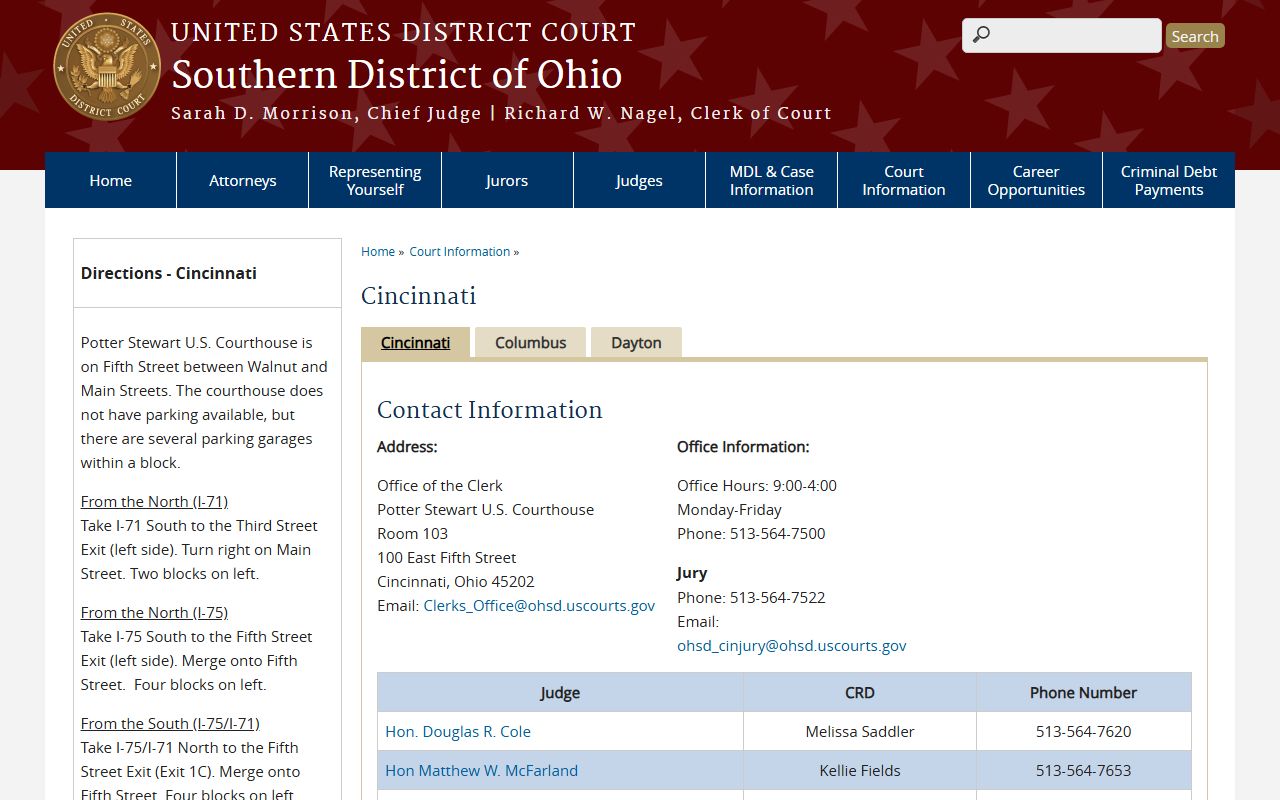
That page is the starting point for anyone who needs to contact the federal district court, find a judge's chambers, or get directions to the Potter Stewart courthouse.
Bankruptcy matters for Hamilton County residents are handled by the U.S. Bankruptcy Court for the Southern District of Ohio. The Cincinnati bankruptcy courthouse serves Hamilton and seven surrounding counties. Its address is 221 East Fourth Street, Atrium Two Suite 800, Cincinnati, Ohio 45202. The main phone is 513-684-2572. The building has accessible metered parking around Sycamore and Fourth streets, a wheelchair ramp at the Fourth Street entrance, accessible elevators, courtroom wheelchair space, accessible restrooms on the eighth floor, and assistive hearing devices. Bankruptcy filings and dockets are also searched through PACER.
The screenshot below comes from the U.S. Bankruptcy Court Cincinnati page, which provides location details, ADA accommodations, and contact information for Hamilton County residents with bankruptcy matters.
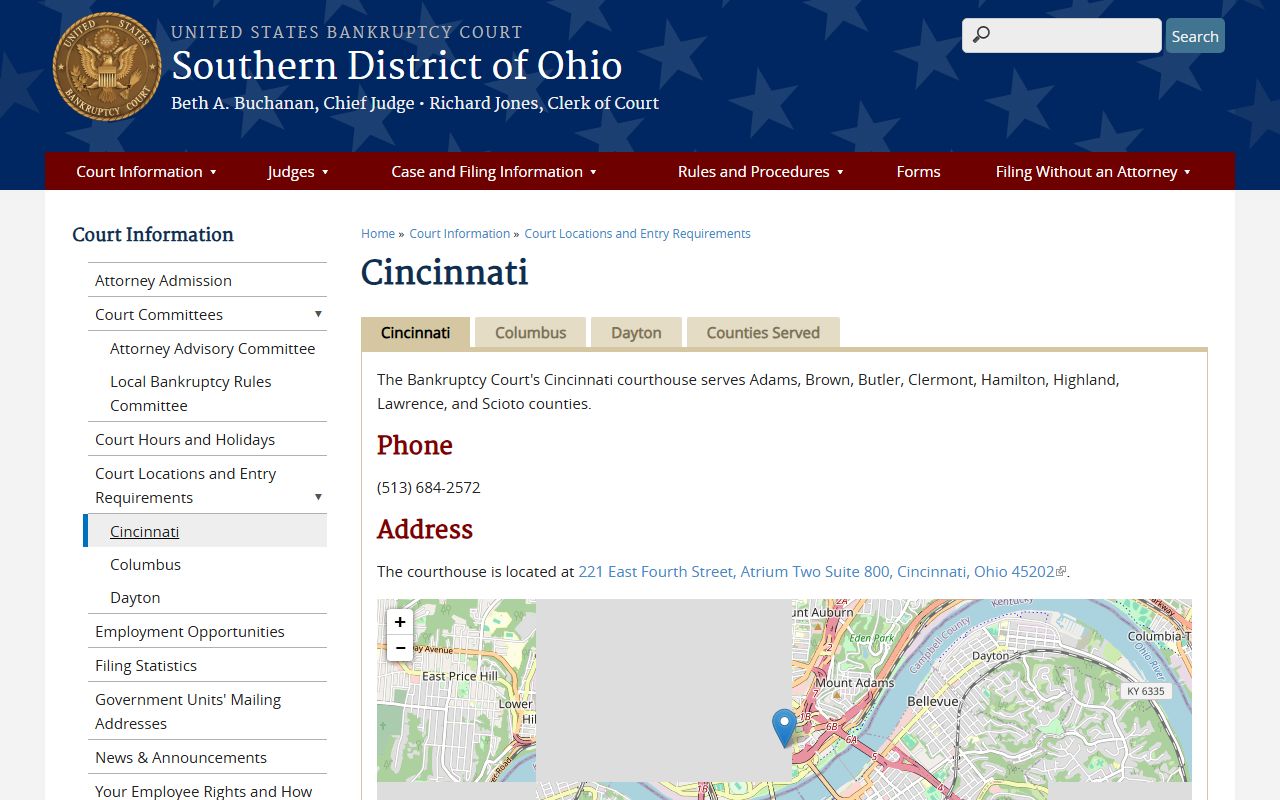
The bankruptcy court's ADA resources and parking guidance are particularly useful for those attending hearings or filing documents in person.
Federal criminal defendants who cannot afford a lawyer are represented by the Federal Public Defender for the Southern District of Ohio. The Cincinnati office handles indigent defense in federal district court proceedings. The U.S. Attorney's Office for the Southern District of Ohio, led by U.S. Attorney Dominick S. Gerace II (sworn in August 11, 2025), prosecutes federal crimes and represents the United States in federal civil cases from offices in Cincinnati, Columbus, and Dayton.
The screenshot below is from the Federal Public Defender Cincinnati office page, which provides contact information and resources for defendants in federal proceedings originating from Hamilton County.
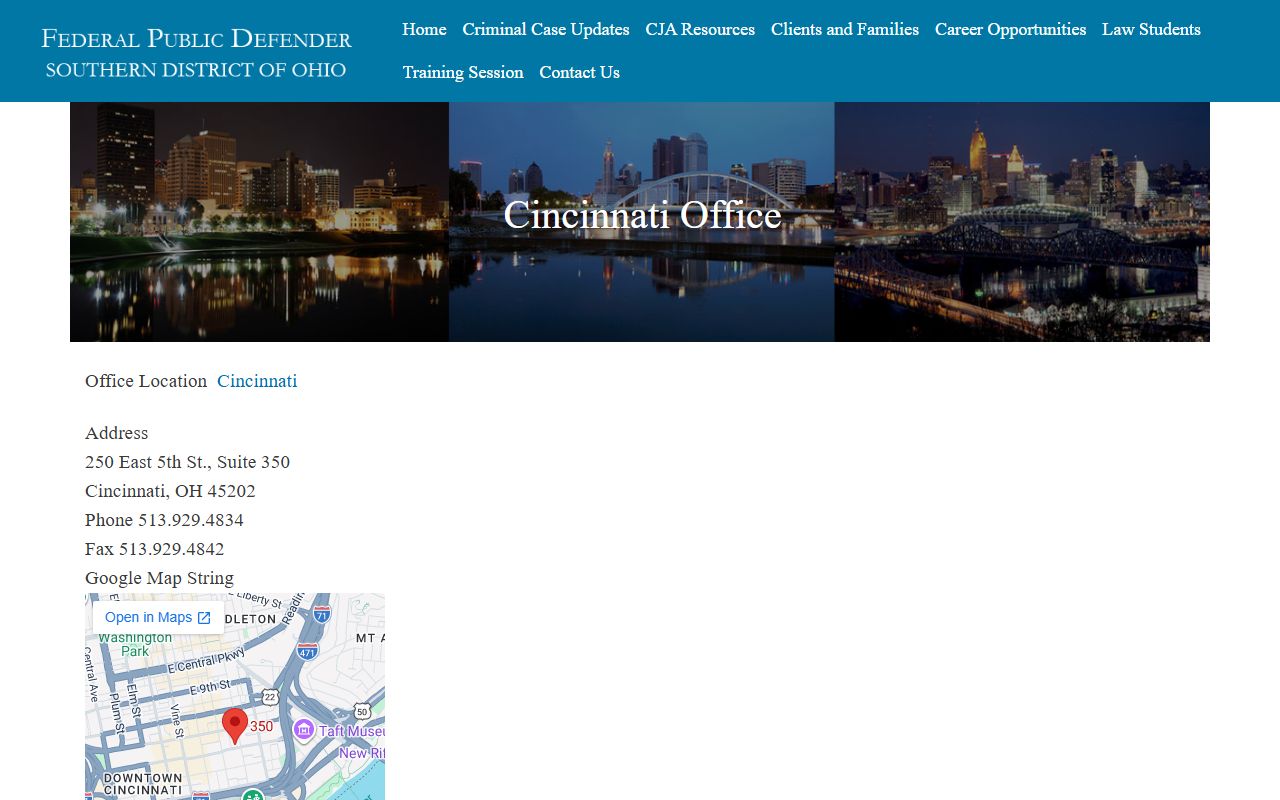
Anyone facing federal charges in the Southern District of Ohio should contact the Federal Public Defender's Cincinnati office early in the process to determine eligibility for appointed counsel.
History of the Hamilton County Court System
Hamilton County is one of Ohio's oldest counties, with Cincinnati as its county seat. The courthouse at 1000 Main Street has a long downtown history. The current building is still active and houses the Common Pleas and Municipal courts along with the law library. It was modernized in the 1950s, when ceilings were lowered and windows replaced. A second renovation in the 1980s brought new windows, updated heating and air conditioning, and bronze doors designed to replicate the original courthouse doors from an earlier era.
The downtown legal district is unusually concentrated. Within a compact area, visitors can find the Hamilton County Courthouse, the First District Court of Appeals, the U.S. Court of Appeals for the Sixth Circuit, the Potter Stewart U.S. Courthouse, and a U.S. Bankruptcy Court location. The William Howard Taft Courthouse and Law Center at 230 East Ninth Street houses both the Probate Court and the First District Court of Appeals, named after the 27th U.S. President and Chief Justice who was born in Cincinnati. That density means a single case involving both state and federal questions can be handled within a short walk in downtown Cincinnati.
The Hamilton County Drug Court, operating under the Common Pleas General Division, holds a notable place in Ohio history as the first drug court established in the state. Specialized courts of this kind have since spread across Ohio and the country. The Reentry Docket is another program that reflects the court's ongoing work to connect sentenced individuals with community services before and after release from state prison.
Self-Help and Legal Aid for Common Pleas Cases
Not everyone who appears in the Court of Common Pleas has a lawyer. Self-represented litigants can use several free resources in Hamilton County. The Hamilton County Help Center, linked directly from the Clerk of Courts, assists people who represent themselves in common civil and court-navigation matters. It is part of Clerk Pavan Parikh's access-to-justice program.
The Legal Aid Society of Greater Cincinnati provides free civil legal help to low-income residents in housing, family law, benefits, consumer, and other civil matters. Ohio Legal Help is a statewide plain-language resource covering sealing and expungement, family law, housing, debt, and forms for pro se filers. For private-lawyer referrals, the Ohio State Bar Association maintains a lawyer referral service.
Defendants in criminal cases who cannot afford counsel should ask the court at arraignment for appointed counsel. The Hamilton County Public Defender handles indigent defense in criminal and juvenile cases for eligible defendants. The office has attorneys assigned specifically to felony trial work and the Drug Court docket. For federal criminal matters, eligible defendants should contact the Federal Public Defender's Cincinnati office.
Note: Probate Court provides its own form library covering adoptions, estate administration, guardianship, name changes, trusts, will deposit, and many other probate matters. Those forms are available through the Probate Court website.