
What Hamilton County Probate Records Cover
The Hamilton County Probate Court has broad jurisdiction that goes well beyond simple estate work. It handles estates, wills, trusts, guardianships, conservatorships, marriage licenses, mental-health probate, adoptions, name changes, custodial accounts, civil commitment, birth corrections and registrations, minor settlements, and adult-ward settlements. That range is one reason the Probate Court maintains its own public inquiry system separate from the general Clerk of Courts portal.
The Probate Court sits within the Court of Common Pleas structure under Ohio law, but it operates as a highly visible, stand-alone office at the William Howard Taft Courthouse and Law Center at 230 East Ninth Street in Cincinnati. Most people deal with Probate Court when a family member dies, when a minor or incapacitated adult needs a legal guardian, or when a couple applies for a marriage license. The court's archives add a genealogy dimension: the Archive Search reaches bound-volume records from 1791, making it one of the oldest continuously maintained local court archives in Ohio.
Ohio law defines wills and related probate concepts in R.C. 2107.01, which is the starting point for the Ohio Revised Code's wills chapter. The deposit of wills with the Probate Court is governed by R.C. 2107.07. Estates that fall below certain value thresholds may qualify for release from administration rather than full probate; that path is governed by R.C. 2113.03.
Note: adoptions and certain mental-health probate files carry confidentiality protections that limit public access even when the case appears in the index.
Probate Terms You Will See in Hamilton County Records
Probate filings use legal language that can be confusing if you have not dealt with this area before. The terms below appear often in Hamilton County Probate Court case records and docket entries. Understanding them helps you read a case correctly and know what to expect at each stage of the process.
- Testator
- The person who made a will. When a testator dies, the will is submitted to Probate Court for admission. The court determines whether the will is valid before estate administration begins.
- Executor
- The person or institution named in the will to carry out its terms, gather assets, pay debts, and distribute property to beneficiaries. Ohio also uses the term "administrator" when the court appoints someone in the absence of a valid will or a named executor who can serve.
- Intestate
- Dying without a valid will. An intestate estate follows Ohio's statutory distribution rules rather than the wishes of the deceased. The Probate Court appoints an administrator to handle the estate.
- Guardianship
- A court-supervised relationship in which a guardian is appointed to make personal decisions for a minor or an adult who cannot care for themselves. Guardianship cases are filed in Probate Court and appear in the Case Search index.
- Conservatorship
- A court arrangement in which a conservator manages the financial affairs or property of a person who is unable to manage them independently. In Ohio, conservatorship is sometimes handled alongside or as part of a guardianship proceeding.
The Hamilton County Probate Public Inquiry System
Hamilton County Probate Court provides a free online public inquiry system at probatect.org/recordsearch/. The system gives public access to four distinct search types, each covering a different category of Probate Court records. You do not need an account or login to use it.
The screenshot below is sourced from the Ohio Revised Code wills chapter at codes.ohio.gov, which provides the statutory foundation for will-related probate records in Hamilton County.
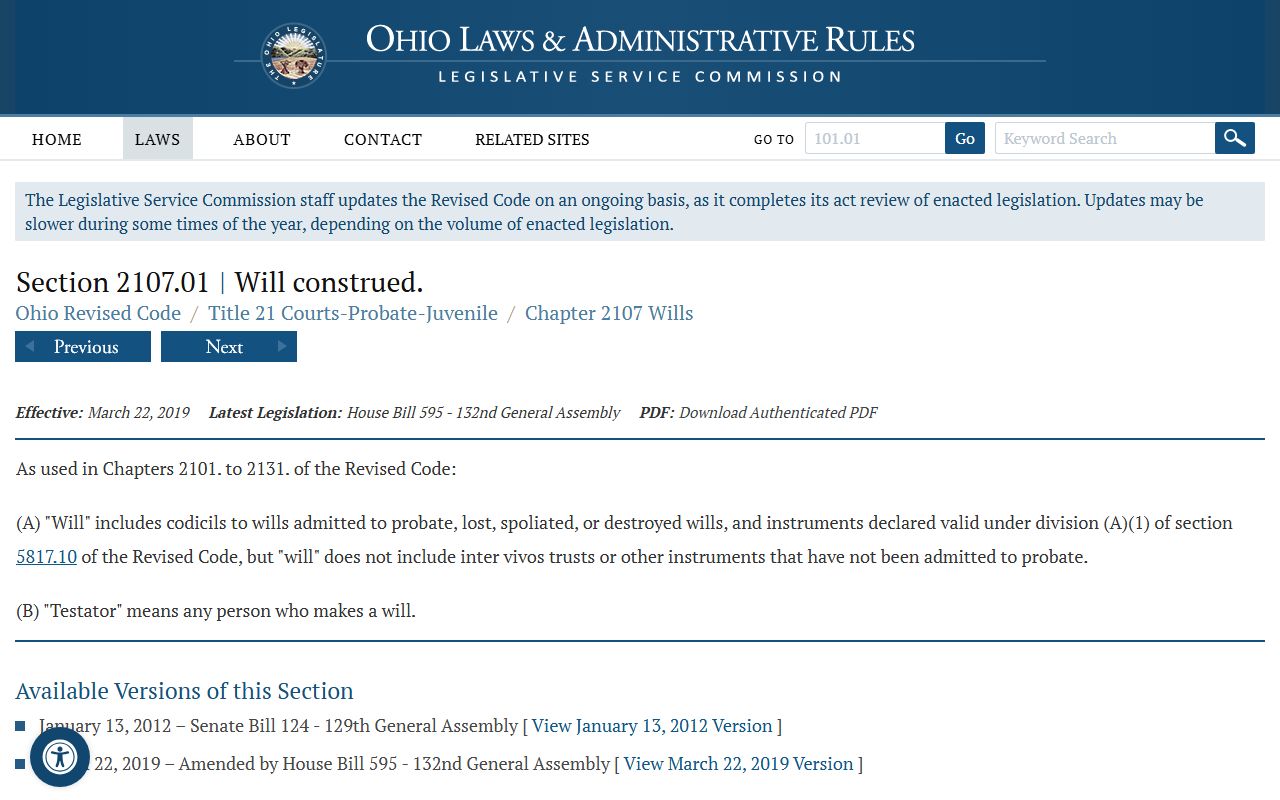
That statutory text is what backs Hamilton County Probate Court's authority to admit, file, and maintain estate and will records that the public can then search through the inquiry system.
The four search types and their coverage are shown in the table below. Each type has a different date range, and some have access restrictions that apply even though the index entry is visible.
| Search Type | What It Covers | Coverage Notes |
|---|---|---|
| Case Search | All probate cases except Marriage License and Mental Health; clicking DETAIL shows the case docket; docket entries may link to PDF or TIF image. | Case index since Jan. 1, 1974; docket since Jan. 1, 1993; documents since Jan. 1, 2000. |
| Marriage License | Alphabetical index of brides and grooms who applied for a Hamilton County marriage license. | Index covers applicants since Jan. 1, 1984. |
| Mental Health | Index of persons probated for mental illness or intellectual disability; DETAIL shows docket when access is permitted. | Index since Jan. 1, 1987; records are sensitive and access may be limited by court order or privacy law. |
| Archive Search | Bound-volume historical records: estates, wills, trusts, guardianships, marriages, minister licenses, birth records, naturalizations, journal entries, physician certificates. | Earliest records date from 1791; scope and image availability vary by record category and age. |
For most estate and guardianship searches, Case Search is the right starting point. Use the Marriage License search when you need a record of a Hamilton County application since 1984. Older marriages and historical genealogy work typically call for Archive Search.
How to Search Hamilton County Probate Records Online
The public inquiry system at probatect.org/recordsearch/ is free and does not require an account. The steps below follow the Case Search path, which covers most estate, guardianship, trust, and name-change cases. The same system hosts Marriage License, Mental Health, and Archive Search, which have separate entry points on the same page.
- Go to probatect.org/recordsearch/ and select the search type that fits your need: Case Search, Marriage License, Mental Health, or Archive Search.
- For Case Search, enter the name of the decedent, ward, or applicant, or use the case number if you have it.
- Review the index results. Each result shows a case number, case type, and party name.
- Click DETAIL on the case you want to open the full docket. Docket entries are listed with dates and descriptions.
- For cases filed since Jan. 1, 2000, docket entries may include a PDF or TIF image link. Click the link to view or save the document.
- For records predating 2000 or not available online, contact the Probate Court directly to request copies or to view records in person at the courthouse.
- For archive records, use the Archive Search option. Browse by record category and look for the relevant book or volume reference.
Marriage License searches work the same way but use the separate Marriage License index tab. Enter a bride or groom name to pull up matching records from the 1984-present index. For historical marriages before 1984, the Archive Search covers imaged marriage-record books and marriage banns back to the earliest Hamilton County records.
What Hamilton County Probate Records Show
When you open a case through the public inquiry system, you see a standard set of fields that the Probate Court captures for every case. Not every field appears in every case type, and older records accessed through Archive Search may use a volume-and-page format rather than modern docket entries. The field inventory below covers the core information found in a typical active probate case.
- Case number and index entry - the unique identifier the Probate Court assigns to each case at filing.
- Case type or category - estate, guardianship, trust, name change, adoption, conservatorship, or other probate matter.
- DETAIL link - opens the full docket view with individual entries, dates, and any available document links.
- Docket entries - chronological log of filings, orders, hearings, and events; some entries include color-coded docketing to indicate status.
- PDF or TIF image links - available for docket entries where scanned documents exist; most documents available since Jan. 1, 2000.
- Parties - decedent, ward, applicant, fiduciary, guardian, trustee, and beneficiaries or heirs when publicly available.
- Filing dates and entry dates - when documents were submitted and when the court acted.
- Journal entries - court orders and decisions recorded in the official journal.
- Archive category and volume references - for older bound-volume records, the book and page or volume number that locates the physical record.
Hamilton County Probate Court Contact Information
The Probate Court is the sole office that handles probate matters in Hamilton County. It is located on the 9th and 10th floors of the William Howard Taft Courthouse and Law Center at 230 East Ninth Street in downtown Cincinnati. Marriage license applications, certified copy requests, and in-person record searches are all handled at this address. The court has its own website, forms library, and fee calculators separate from the general Clerk of Courts system.
Hamilton County Probate Court
William Howard Taft Courthouse and Law Center
230 E. Ninth Street, 9th and 10th Floors
Cincinnati, OH 45202
Marriage License Office: 513-946-3589
Paid and metered parking is available around the East Ninth Street building. Probate Court references nearby street and garage parking options, but published rates should be confirmed before arrival. The Probate Court is on separate floors from the First District Court of Appeals, which also uses the 230 East Ninth Street address.
Probate Filing Fees in Hamilton County
Hamilton County Probate Court has fee calculators available through its official website for estate and other probate filings. Specific fee amounts for estate applications, letters testamentary, guardianship applications, and certified copies were not published as a flat schedule in the official pages inspected. Fees often scale with estate value or other case-specific factors under Ohio court rules, which is why the court provides calculators rather than a simple dollar list.
What is confirmed from official sources is the marriage license fee structure. The Probate Court is the issuing office for Hamilton County marriage licenses, and fee information for that service is publicly documented.
| Item | Amount / Rule |
|---|---|
| Marriage license fee | $75 (cash, credit card, or debit card; no checks) |
| Credit card processing fee | Additional processing fee applies to card payments |
| Marriage license correction fee | $90 if information on the license must be corrected |
| Estate and probate filing fees | Use fee calculators at probatect.org; fees vary by case type and estate value |
| Certified copies | Contact Probate Court directly for current certified-copy fees |
For all estate, guardianship, trust, and name-change filings, contact the Probate Court at 513-946-3589 or check the fee calculators on the court's website before filing to confirm current amounts.
The Estate Process at Hamilton County Probate Court
When a person dies in Hamilton County, their estate may need to go through Probate Court depending on the value of assets and how property was titled. Ohio law provides several paths, from full administration to a simplified release-from-administration process for smaller estates under R.C. 2113.03. The steps below reflect the general sequence for an estate that requires probate in Hamilton County. Individual cases vary based on whether there is a will, the size of the estate, and whether family members agree on distribution.
- Determine whether the estate requires full probate administration or whether the value and asset types qualify for release from administration under R.C. 2113.03.
- If the decedent left a will, file it with the Probate Court under R.C. 2107.07. Ohio allows any person to deposit a will with Probate Court during the testator's lifetime for safekeeping.
- File the application to open the estate and appoint an executor or administrator. Use the Probate Court's estate-administration form set, available on the court's official forms page.
- The court reviews the application, admits the will if one exists, and issues letters testamentary or letters of administration to authorize the fiduciary to act on behalf of the estate.
- The executor or administrator files an inventory and appraisal of estate assets with the Probate Court within the required time. Notice to heirs and creditors is given as required by Ohio law.
- Pay valid debts and claims, including taxes, from estate funds. File any required accountings or reports with the court.
- Distribute remaining assets to beneficiaries named in the will or, if intestate, to heirs according to Ohio's intestacy statutes.
- File a final account with the Probate Court and obtain a court order closing the estate. Request certified copies of any orders or decrees needed for asset transfers.
Each step generates docket entries in the Probate Court public inquiry system. Once the case is filed, anyone can track the docket through the Case Search at probatect.org/recordsearch/ using the case number or the decedent's name.
Hamilton County Probate Archive Search and Historical Records
The Archive Search in the Probate public inquiry system covers bound-volume records that predate the modern electronic filing system. The earliest records in the archive date from 1791, giving Hamilton County Probate Court one of the deepest genealogical records collections among Ohio county courts. Archive records include estates, wills, trusts, guardianships, marriages, minister licenses, birth records, naturalizations, journal entries, and physician certificates.
These records are online through the Archive Search option at the public inquiry system. Coverage and image availability vary by record category and by how far back a given record type was imaged. For records that were not digitized or that require higher-quality copies, contact the Probate Court to arrange in-person viewing or a certified copy request. Birth records and naturalization records in the archive are especially relevant for genealogy research, because Hamilton County was the entry and settlement point for a large immigrant population in the 19th and early 20th centuries.
The imaged historical marriage-record books and marriage banns list is also accessible through a separate PDF published by the Probate Court, showing which volumes have been scanned and are available online. For marriages before Jan. 1, 1984, the modern Marriage License index does not apply; researchers should use Archive Search or contact the court for guidance on which book covers the relevant year.
Note: archive records involving adoptions or certain mental-health matters remain subject to confidentiality rules even when the index entry is visible in the search system.
Restricted Probate Records in Hamilton County
Most Probate Court records are public, but two categories carry significant confidentiality protections. Mental-health probate records and adoption records are the two main areas where access is limited even if an index entry is visible in the public inquiry system.
Mental-health probate cases cover persons probated for mental illness or intellectual disability. The Mental Health index in the public inquiry system shows entries since Jan. 1, 1987. However, the underlying records are sensitive and may be subject to limited access under court orders or Ohio privacy law. Clicking DETAIL on a mental-health case will show docket entries to the extent permitted, but the full file may not be available without a court order or statutory authorization.
Adoption files are generally confidential. Ohio law restricts public access to adoption records, and accessing them requires either statutory eligibility, a court order, or participation as a named party in the proceeding. Adoption cases may appear in the Probate Court index but the full file is not open to the public in most circumstances.
Other records in the Probate system are not restricted in the same way. Estate inventories, wills admitted to probate, guardianship appointments, and trust filings are generally available through the Case Search once they are filed with the court. Some personal identifiers, such as Social Security numbers, may be redacted in documents that appear online, consistent with Ohio court practice.