
How to Find Recently Released Hamilton County Inmates
Hamilton County does not publish a standalone recently released inmate list on any official page inspected. Release status must be pieced together from the tools that do exist. The starting point is the HCSO inmate search, which covers people currently in custody at the Hamilton County Justice Center at 1000 Sycamore Street, Cincinnati. If a name no longer appears in that search, the person may have been released, transferred, or moved to a different housing unit. The Sheriff's Office warns that housing location and other details can change without notice, so a blank result is not always proof of release.
The safest next step after a blank result is a phone call. The Hamilton County Sheriff's Office main line is 513-946-6400. A staff member can confirm whether a person was released from the Justice Center, transferred to the Ohio Department of Rehabilitation and Correction for a state sentence, or moved for other reasons. For victims and families who need more than a one-time check, VINELink provides automated notifications covered in the next section.
The HCSO inmate search uses two filters: Last Name and First Name. The table below shows those fields as they appear in the portal.
| Field Label | Type | Required | Notes |
|---|---|---|---|
| Last Name | Text | Unspecified | Filter current county custody by surname. |
| First Name | Text | Unspecified | Use with surname to narrow results. |
| Go | Button | n/a | Executes the search query. |
The HCSO inmate property page shows what happens to belongings at release. The screenshot below comes directly from that page.
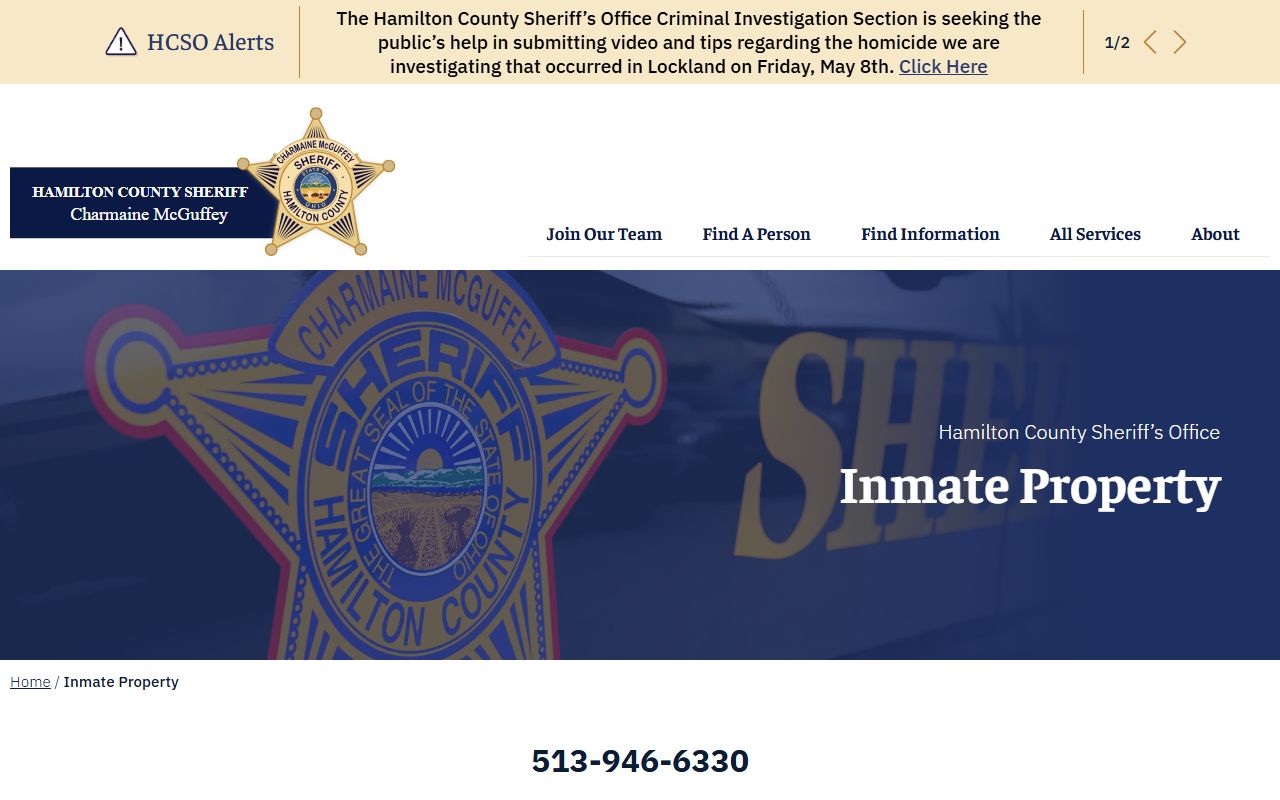
Property can be picked up at the Justice Center South Building with valid ID. Items left at the facility can be shipped at the receiving person's expense using a prepaid box. If someone placed a commissary order before release, the amount is refunded 48 hours after the scheduled delivery day.
Setting Up Release Notifications in Hamilton County
VINELink is the national custody notification system used by victims, attorneys, and family members who need to know the moment a person's status changes. Ohio jails and prisons participate in VINE, so people held at the Hamilton County Justice Center are trackable through the system. A registered user receives an automatic call, text, or email when an offender is released, transferred, or when their custody status changes in the connected database. Registration is free.
To set up an alert, go to vinelink.com and follow these steps.
- Visit the VINELink site and select Ohio as the state or search by facility to find the Hamilton County Justice Center.
- Search by the person's name or inmate ID to locate the custody record.
- Create a VINELink account and register for notifications, choosing phone call, email, or text as your preferred method.
- Confirm your contact details. The system will send a test notification so you know it is working.
- Keep your contact information current, and re-register if you do not hear back on a notification you expected.
The VINELink search uses these fields to locate an offender record.
| Field Label | Type | Required | Notes |
|---|---|---|---|
| State / Facility | Dropdown / Search | Yes | Select Ohio or search directly for Hamilton County Justice Center. |
| Name / ID | Text | Yes | Search by the person's name or inmate ID to find the custody record. |
| Notification Method | Account / Contact | Conditional | Phone, email, or text options are set during account registration. |
Note: VINELink data depends on jail systems reporting accurately and on time. If a person was transferred to state prison, the ODRC system may also need a separate notification setup.
Searching State and Federal Released Inmates
When a Hamilton County inmate is transferred to a state prison or has already completed a state sentence, the county inmate search will show no result. The Ohio Department of Rehabilitation and Correction runs a statewide offender search at appgateway.drc.ohio.gov/OffenderSearch. That tool covers people currently in ODRC custody as well as people on post-release control or parole. It does not show former inmates who have fully discharged their sentence with no active supervision.
The ODRC offender search fields are shown below. The county and status dropdown options should be verified in the live portal, as exact filter labels may update.
| Field Label | Type | Required | Notes |
|---|---|---|---|
| Name / Offender Number | Text | Unspecified | Use after county release or when a state prison transfer is suspected. |
| County Filter | Dropdown | Optional | Can narrow results to Hamilton County cases; verify exact label in live portal. |
| Status Filter | Dropdown | Optional | Options may include incarcerated, released, on parole, or post-release control. |
Federal inmates serve time in Bureau of Prisons facilities rather than county jails or state prisons. The BOP inmate locator at bop.gov/inmateloc searches current and recently released federal inmates. A person released from a BOP facility within the past few years may still appear in the locator with a released status. The screenshot below shows the federal BOP inmate locator interface.
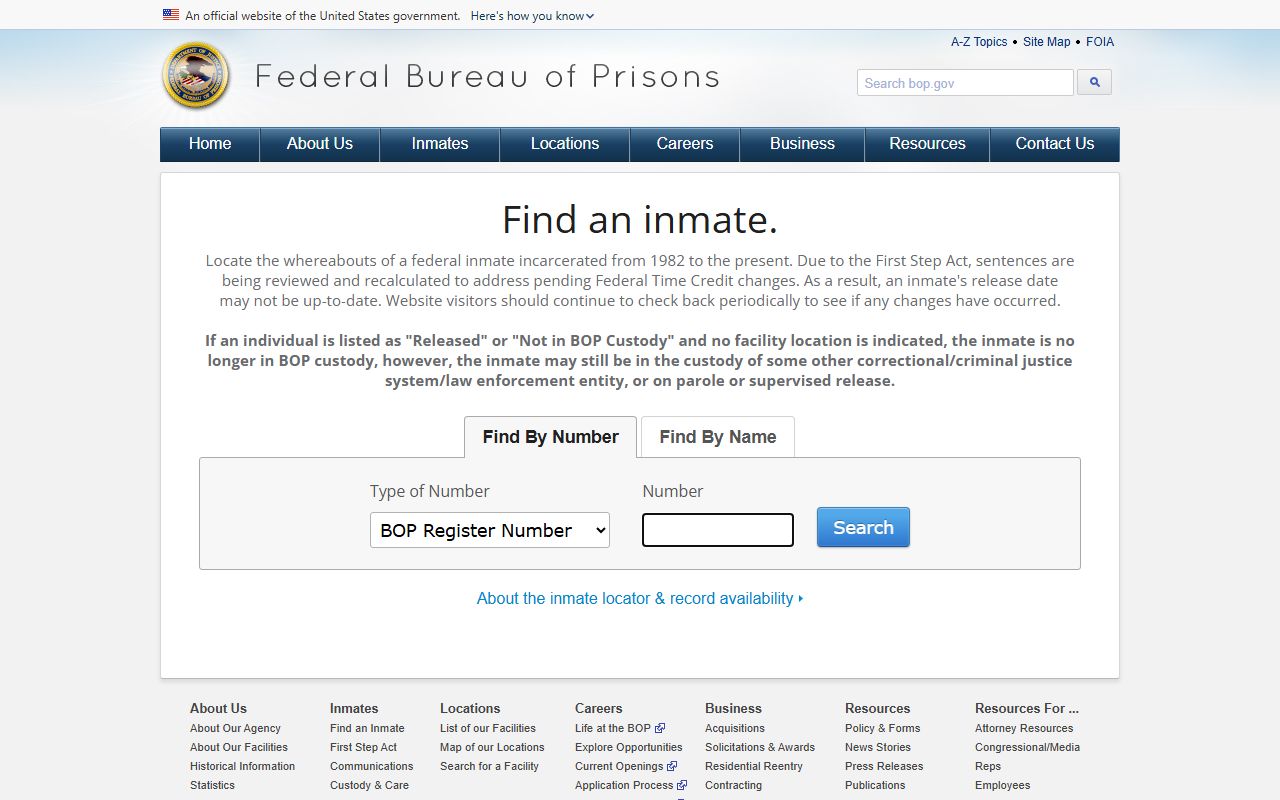
The BOP locator serves a different population than the HCSO or ODRC tools. Federal charges come through the U.S. District Court for the Southern District of Ohio in Cincinnati, not through the Court of Common Pleas. Use this tool when a person faced federal charges.
| Field Label | Type | Required | Notes |
|---|---|---|---|
| Find by Number | Text | Optional | Accepts BOP Register Number, DCDC number, FBI number, or INS number. |
| Last Name | Text | Optional (name search) | Use with first name for a name-based search when no ID is available. |
| First Name | Text | Optional | Pair with last name to narrow results. |
| Race / Age / Sex | Dropdown / Text | Optional | Additional filters to reduce false matches on common names. |
Verifying Hamilton County Release in Person or By Phone
Not every release question can be answered online. The HCSO inmate search only shows current custody. It does not log past bookings or release dates in the public-facing view. If you need written confirmation of a release date or a copy of release records, a direct contact with the Sheriff's Office or a public-records request may be needed.
To verify release by phone, call HCSO at 513-946-6400. Staff can confirm whether a person was released from the Justice Center, transferred to ODRC, or moved elsewhere. For formal records, the Sheriff's public records request form is available online. The HCSO notes that requests may be subject to Ohio R.C. 149.43, which governs public record access and allows charges for records such as body-camera video.
In-person inquiries go to the Hamilton County Justice Center at 1000 Sycamore Street, Cincinnati, OH 45202. The Inmate Accounting office is in the North Building, Room 120, and can be reached at 513-946-6630. The Inmate Property office is in the South Building and can be reached at 513-946-6330. These offices handle financial accounts and property logistics tied to release but are not the same as the records counter.
Hamilton County Sheriff's Office
1000 Sycamore Street
Cincinnati, OH 45202
513-946-6400
Inmate Accounting (North Bldg, Rm 120)
Justice Center, 1000 Sycamore Street
Cincinnati, OH 45202
513-946-6630
Release Pay Debit Card support: 877-287-2448
When an inmate is released, any money left in the inmate account is placed on a Release Pay Debit Card, which works at ATMs and on credit-card networks. The support line for that card is 877-287-2448. This process does not apply to inmates who transfer to another institution rather than being released outright.
Ohio Sex Offender Registry
Ohio requires sex offenders to register with local law enforcement after release, and that registry is publicly searchable. The Hamilton County Sheriff's Office links to a SheriffAlerts/iCrimeWatch sex-offender lookup tool for Hamilton County searches. During inspection, the HCSO-linked entry point at sheriffalerts.com returned a 403 access error, meaning the page was not reachable through an automated browser at the time of research. That system may require direct browser interaction or a current session to load properly. The best approach is to visit the HCSO website at hcso.org and follow the current sex-offender registry link from there.
Ohio's statewide sex offender registry is administered through the Attorney General's office and local sheriff departments. Registrants are required to provide address, physical description, photograph, and offense information. Public registry records typically include these fields.
| Field / Data Point | What It Shows |
|---|---|
| Full Name | Registered name of the sex offender. |
| Photograph | Photo on file with the registering agency. |
| Address / Neighborhood | Current registered address or general area. |
| Offense(s) | Qualifying conviction that required registration. |
| Tier Level | Ohio tier classification (Tier I, II, or III) based on offense severity. |
| Registration Status | Whether the person is currently compliant with registration requirements. |
Ohio sex offenders are classified into three tiers. Tier I offenders register annually for 15 years. Tier II offenders register every 180 days for 25 years. Tier III offenders register every 90 days for life. A person released from Hamilton County on a sex offense conviction must register with the Sheriff's Office within three days of establishing a residence in the county.
Note: Do not use third-party aggregator sites for sex-offender registry data. Always go directly to the HCSO or Ohio Attorney General for current registration information.
Parole and Probation After Hamilton County Release
Ohio uses two main forms of community supervision after release. Probation is a sentence served in the community under court supervision, often instead of or following a short jail term. Parole, now formally called post-release control in Ohio, is the period of supervision that follows release from a state prison sentence. Both are managed through the Ohio Department of Rehabilitation and Correction's Division of Parole and Community Services for state cases, and through the Common Pleas Court probation department for county-level felony probation.
A person on post-release control who violates the conditions can be returned to prison. Conditions commonly include regular reporting, no new criminal charges, restrictions on travel, drug and alcohol testing, and maintaining employment or treatment enrollment. If a person released from ODRC custody plans to live in Hamilton County, they will be supervised by the local parole office. The ODRC offender search at appgateway.drc.ohio.gov/OffenderSearch can show whether someone is on post-release control with an active supervision status.
For Common Pleas felony probation, the assigned probation officer reports to the court. Violations can result in a probation-revocation hearing before the sentencing judge. The Hamilton County Court of Common Pleas handles those hearings through the Court of Common Pleas. Municipal Court misdemeanor probation works the same way at the lower court level. Docket entries for probation violations appear in the Clerk of Courts records search under the relevant case number.
Ohio Dept. of Rehabilitation and Correction
4545 Fisher Road, Suite D
Columbus, OH 43228
Reentry Resources in Hamilton County
Hamilton County has dedicated programs to help people coming out of incarceration find housing, employment, and services. The two main county-run resources are the Hamilton County Office of Reentry and the Common Pleas Reentry Docket. Both focus on reducing the chance that someone returns to jail or prison, and both are connected to a network of local service providers.
The Hamilton County Office of Reentry is a client-driven referral and support organization for people returning from correctional facilities. It links people to services such as housing, job training, substance-use treatment, and benefits assistance. The Office of Reentry also partners with the Common Pleas Reentry Docket to build reentry plans and track outcomes. The screenshot below comes from the Hamilton County Office of Reentry page.
The Common Pleas Reentry Docket is a judicial-release program for low-level, nonviolent offenders who want help moving from state prison back to the community. The presiding judge is Hon. Wende C. Cross. The program requires that participants intend to live in Hamilton County, were sentenced here, qualify for judicial release, are serving a nonmandatory term of less than two years, and have served at least 30 days in ODRC before being screened. Check-in frequency starts at every two weeks and gradually decreases as participants progress through the program.
Hamilton County Office of Reentry
Hamilton County, Cincinnati, OH
Director Trina Jackson: 513-946-4304
Common Pleas Reentry Docket
1000 Main Street, Cincinnati, OH 45202
Judge Wende C. Cross
Reentry Specialist Sheryl Miles: 513-946-5556
Beyond the county programs, several legal and social-service organizations serve people returning to Hamilton County.
- Legal Aid Society of Greater Cincinnati -- free civil legal help for low-income residents, including housing, family law, and benefits.
- Ohio Legal Help -- plain-language statewide resource covering sealing, expungement, family law, housing, and employment rights.
- Hamilton County Public Defender -- indigent criminal defense for eligible individuals with pending or ongoing criminal cases.
- Hamilton County Help Center -- linked directly by the Clerk of Courts for self-represented litigants navigating civil matters.
People returning to Hamilton County can also look at the Reentry Docket's official page for eligibility details, the application process, and program phases. The Reentry Docket held a graduation ceremony in 2024, showing the program is active and taking new participants.
Civil Rights Restoration After Release
Ohio law generally restores voting rights after a person is released from incarceration for a felony. There is no waiting period after release. A person who has served their sentence can register to vote in Ohio right away. People held in jail pretrial or serving a misdemeanor sentence never lose their voting rights in Ohio. This is a key distinction: pretrial detention does not affect voting eligibility.
Firearm rights are a different matter. A felony conviction under Ohio law or federal law bars a person from possessing firearms unless those rights are restored through a separate legal process. Ohio does not have a straightforward administrative restoration process for firearms rights for most felony convictions. Anyone with questions about firearm rights should speak with an attorney before possessing any weapon.
Sealing and expungement are the main tools for addressing the impact of a criminal record on employment and housing. Ohio R.C. 2953.32 governs adult conviction sealing and expungement. A sealed record is removed from public view. An expunged record is deleted or destroyed where the statute allows. Eligibility depends on the type of offense, the sentence received, and any waiting period. The application is filed in the court that handled the case, which for Hamilton County felonies is the Court of Common Pleas. Juvenile records have a separate pathway under Ohio R.C. 2151.356 and 2151.358.
Employment and housing barriers are not automatically removed by release. Employers and landlords may still use background checks, and some licenses have statutory bars tied to certain offenses. Ohio Legal Help at ohiolegalhelp.org covers these barriers and explains what sealing or expungement can and cannot do. The Legal Aid Society of Greater Cincinnati provides direct legal help for eligible residents.
Driver's license reinstatement is handled through the Ohio Bureau of Motor Vehicles. A suspended or revoked license is not automatically restored on release from jail or prison. Fees, requirements, and timelines depend on the reason for the suspension. The Ohio BMV driver record portal at bmv.ohio.gov/dl-records.aspx can help someone confirm their license status before driving.