
Active Warrants in Hamilton County
Warrants in Hamilton County are issued by judges on the Court of Common Pleas and Hamilton County Municipal Court. Common Pleas handles felony matters and major civil cases; the Municipal Court covers misdemeanors, traffic offenses, small claims, and evictions. Either court can issue a warrant or capias when the law and the facts of a case call for it. The Hamilton County Clerk of Courts is the unified record keeper for both courts and maintains the public docket index where those warrant and capias entries appear.
There is no single "active warrant list" published as a standalone webpage for Hamilton County. Warrant information surfaces through the Clerk's criminal and traffic docket search, where entries like capias issued, failure to appear, or bond forfeiture appear in the case event log. A person or attorney checking for an outstanding Hamilton County warrant should search the Clerk's portal by name or case number and look for those docket events. If the warrant has been served and the person is now in custody, the Hamilton County Sheriff's Office inmate search at hcso.org shows current jail status.
The Hamilton County Prosecuting Attorney, Connie Pillich, handles felony charges that follow many arrest and bench warrants through the Court of Common Pleas. For federal warrant matters, the U.S. Attorney's Office for the Southern District of Ohio prosecutes federal crimes in Cincinnati. Dominick S. Gerace II was sworn in as U.S. Attorney for the Southern District on August 11, 2025. Federal cases do not appear in the Clerk's county portal; they are tracked through PACER at pacer.uscourts.gov.
Types of Hamilton County Warrants
Ohio courts use several distinct warrant types, and each one arises from different legal circumstances. Understanding the difference matters if you are trying to find a specific docket entry or figure out what a court order requires.
- Arrest warrant - Issued after a judge or magistrate finds probable cause, or after a grand jury returns an indictment; authorizes law enforcement to take a named person into custody.
- Bench warrant - Issued directly by a judge when a defendant misses a hearing, violates a court order, fails to pay a fine, or is in contempt; most bench warrants carry a bond amount.
- Capias - The Ohio court term for an order to take a person into custody and bring them before the court; bench warrants are often entered as capias orders in the Clerk docket, and the term appears in Municipal Court traffic and criminal dockets for failure-to-appear events.
- Search warrant - Authorizes law enforcement to search a specific place or person; search warrants are typically sealed during active investigations and are not accessible through the public Clerk index until proceedings are complete.
- Fugitive warrant / holder - Used when another jurisdiction has an outstanding warrant and Hamilton County law enforcement is asked to detain and hold the individual for transfer.
- Civil enforcement / body attachment - May appear in Domestic Relations or civil contempt matters, such as failure to comply with child support orders; these show up in the Domestic Relations docket within the Clerk portal.
The Municipal Court's navigation includes a "Failure to Appear in Court" section, which reflects how common capias and bench warrant entries are on the traffic and misdemeanor side. The Municipal Criminal/Traffic Clerk at the Justice Center handles traffic and criminal tickets, and those records are searchable through the Clerk portal under the Municipal Criminal/Traffic category.
How to Search Hamilton County Warrant Records
The primary tool for a Hamilton County warrant search is the Clerk of Courts Records Search at courtclerk.org. The landing page is a directory, not a single search box. For warrant and capias information, the two most useful paths are the name search and the case-number search, both of which pull from the criminal and traffic dockets where warrant events are logged. You can also call the Municipal Criminal/Traffic Clerk counter at the Justice Center, 1000 Sycamore Street, Room 115, which is open 8 a.m. to 8 p.m. Monday through Friday, with a bond window and police attorney counter that runs 24 hours a day, seven days a week.
- Go to the Clerk of Courts Records Search page and choose either Search by Name or Search by Case Number.
- On the name search, enter the last name and first few letters of the first name for best results; select Common Pleas Criminal or Municipal Criminal/Traffic as the court category, or toggle all categories if you are unsure which court issued the warrant.
- Add a date of birth in the criminal name-search field to narrow results when the name is common; date range fields are also available.
- Review the docket entries for each case returned; look for entries labeled capias, bench warrant, failure to appear, bond forfeiture, or warrant issued.
- If the case number is known, use Search by Case Number and select the matching court category to pull up the full docket directly.
- If the warrant may have been served and the person may be in custody, check the HCSO inmate search by last and first name to confirm current custody status.
- After reviewing docket entries and custody status, contact the Clerk or court counter before taking any further steps, especially if bond payment or a court appearance is needed.
The Clerk's search does not include City of Cincinnati parking violations. Background checks are not performed through the online portal; formal background checks are available in person at the Justice Center, Room 100, Monday through Friday 7 a.m. to 3 p.m. Do not rely on unofficial warrant listing sites, since they draw from the same public docket data but may be outdated or incomplete.
The screenshot below comes from the Hamilton County Prosecuting Attorney's Office website. The Prosecuting Attorney, Connie Pillich, works alongside the courts when felony warrants are issued and prosecutes the underlying cases once defendants are brought before the Common Pleas Court.
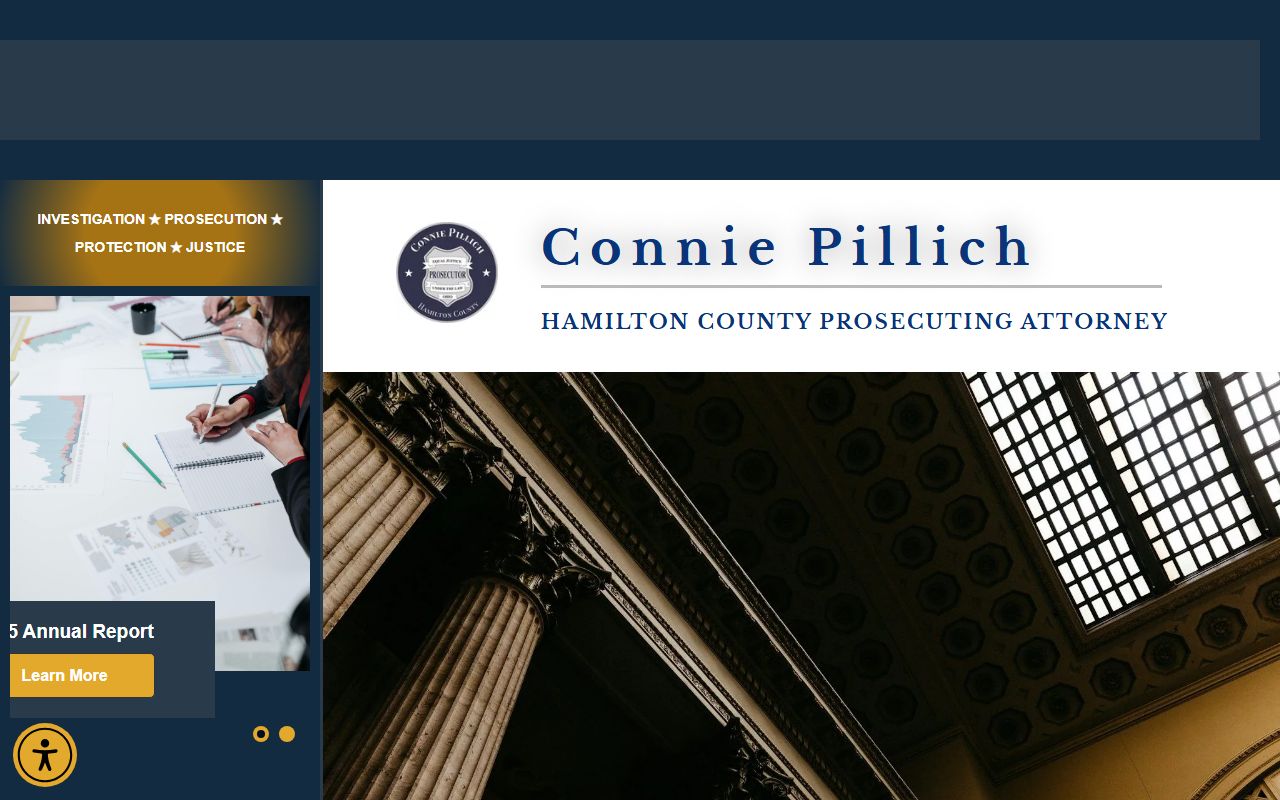
Many Hamilton County arrest warrants originate from felony indictments that the Prosecuting Attorney's Office presents to the grand jury. When an indictment is returned, the Common Pleas Court issues a warrant and it appears in the Clerk docket shortly after.
Hamilton County Warrant Search Portal Fields
The Clerk's criminal and traffic dockets are the public-facing database where warrant and capias entries live. The table below shows the search fields available across the four portals most relevant to a Hamilton County warrant search. Each portal covers a different slice of the data, so checking more than one is often necessary.
| Portal | Key Fields | Required | Notes |
|---|---|---|---|
| Clerk Criminal/Traffic Name Search | Court category, Last Name, First Name, Date of Birth, Date From, Date To | Last Name implied; DOB for criminal only | Searches public criminal/traffic dockets for capias, FTA, and warrant entries; enter last name and first few letters of first name for best results. |
| Clerk Case Number Search | Case Number, Court category | Case Number required | Best when the warrant is tied to a known case number; pulls the full docket for that case including warrant events. |
| HCSO Inmate Search | Last Name, First Name | Neither field marked required; enter at least last name | Confirms whether person is currently in custody after a warrant arrest; housing location subject to change without notice. |
| HCSO Sex Offender Lookup | Not captured | Unknown | HCSO links to the SheriffAlerts/iCrimeWatch system; that page returned a 403 error during inspection. Access may require direct browser interaction. Do not rely on third-party copies of this data. |
Court categories on the name search include: Common Pleas Civil, Common Pleas Criminal, Municipal Civil, Municipal Criminal/Traffic, Domestic Relations, and Court of Appeals. For warrant purposes, Common Pleas Criminal and Municipal Criminal/Traffic are the most likely categories. If you are unsure, toggle all categories so you do not miss a record filed in a division you did not expect.
Note: The Clerk warns that data-mining efforts have hampered the redaction process, and some document requests may require a second request after the initial search result is returned.What a Hamilton County Warrant Record Shows
When a warrant or capias entry appears in the Clerk docket, the information visible in the public record is drawn from the underlying case file. Not every field is present in every warrant type, and some data may be redacted under Ohio law or by court order. The list below reflects the fields documented in Section 17 of the Hamilton County research and cross-referenced with the Clerk's public case-record field inventory from Section 6.
| Field | What It Shows |
|---|---|
| Name / Defendant | Full name of the person subject to the warrant or capias, as filed in the case. |
| Case Number | Division-specific identifier; format varies by court. Use this to pull the full docket directly. |
| Court and Judge | Which division issued the warrant (e.g., Common Pleas Criminal, Municipal Criminal/Traffic) and the assigned judge or magistrate. |
| Charge or Underlying Case | The criminal charge, civil matter, or support case that gave rise to the warrant or capias. |
| Warrant / Capias Issue Date | The docket entry date when the court issued the warrant or capias order. |
| Reason | Why the warrant was issued: failure to appear, probation violation, contempt, indictment, or no-bond holder. |
| Bond Amount / Type | If a bond was set by the court, the amount and whether it is a surety bond, cash bond, or recognizance release. |
| Status | Active, served, recalled, or quashed. Active means the warrant has not been resolved. |
| Next Hearing | Any scheduled court date tied to the case; may appear in the docket or the court-date search function. |
| Arresting / Holding Agency | If the warrant has been served, which agency made the arrest; may link to the HCSO custody record. |
Social Security numbers, personal identifiers, ongoing investigation records, medical records, and BMV data are exempt from public disclosure under Ohio law and the Clerk's public-records policy. Sealed records are withheld entirely. If a docket entry references a document that is not available online, Ohio Sup.R. 45(C) allows the Clerk to require an in-person visit or a formal record request rather than remote access.
What to Do If You Have an Outstanding Warrant
Finding out you have an active warrant is not the same as knowing how to handle it. The right steps depend on what kind of warrant it is, whether bond has been set, and what the underlying case involves. A bench warrant for a missed traffic hearing is handled differently from a felony indictment warrant. Moving quickly and with legal guidance tends to produce better outcomes than waiting.
- Search the Clerk of Courts portal by your name and select Common Pleas Criminal or Municipal Criminal/Traffic to find the case and the docket entry that shows the warrant or capias.
- Note the case number, court, judge, and any bond amount listed in the docket. You will need this information when you call the Clerk or appear at the counter.
- Call the relevant Clerk counter. For Municipal Criminal/Traffic matters, the counter at the Justice Center, 1000 Sycamore Street, Room 115, is open 8 a.m. to 8 p.m. Monday through Friday, and the bond window runs 24 hours a day, seven days a week.
- Contact the Hamilton County Public Defender if you cannot afford private counsel. The Public Defender provides indigent criminal defense for eligible defendants and has staff who handle felony trial work and specialty assignments.
- If bond is set, confirm the exact amount and acceptable payment method with the Clerk or bond window before attempting to pay or surrender.
- After the warrant is recalled, quashed, or resolved, verify the docket update in the Clerk portal and keep copies of any receipts or court entries confirming the recall.
Important: Consult a licensed Ohio attorney before voluntarily surrendering on a warrant; some warrant types require arrest and judicial review before release is possible.
For felony warrant matters, the Hamilton County Public Defender and private attorneys familiar with the Court of Common Pleas and the Hamilton County Prosecuting Attorney's Office can advise on the likely outcome. Ohio Legal Help at ohiolegalhelp.org and the Hamilton County Help Center provide free self-help resources for those who are not yet represented.
The 24/7 Bond Window and Justice Center Counter
Hamilton County's bond process runs through the Municipal Criminal/Traffic Clerk at the Justice Center, which has some of the most accessible hours of any counter in the courthouse complex. Most Clerk division counters close at 4 p.m. The Justice Center counter stays open much later and the bond function never closes.
The Municipal Criminal/Traffic Clerk is at 1000 Sycamore Street, Room 115, Cincinnati, OH 45202. The public counter is open 8 a.m. to 8 p.m. Monday through Friday. The bond window and police attorney counter operates around the clock, 24 hours a day, seven days a week. That means bond on a warrant can be posted at any hour, including nights and weekends, without waiting for the courthouse to open. If a warrant lists a bond amount, confirm the current figure at the bond window because bond conditions can be modified by the court after the initial entry.
The bond window handles cash bonds, surety arrangements confirmed through licensed bail agents, and recognizance releases when the court has authorized them. A person who posts bond on a capias or bench warrant is typically released on the condition that they appear at the next scheduled court date. Missing that appearance triggers a new capias and forfeits the bond. Bond and release terms should be discussed with counsel so the conditions are understood before the person leaves the facility.
Federal Warrant Records in Hamilton County
Federal warrants are issued by U.S. District Court judges and magistrates and are separate from county court warrants. Hamilton County sits within the U.S. District Court for the Southern District of Ohio, Cincinnati seat. Federal cases are tracked through PACER, the federal docket system, not through the Clerk of Courts county portal.
The screenshot below is from the U.S. Attorney's Office for the Southern District of Ohio official page. Federal prosecutions that result in arrest warrants originate with indictments or criminal complaints filed through the U.S. Attorney's Office and reviewed by a federal magistrate or district judge.
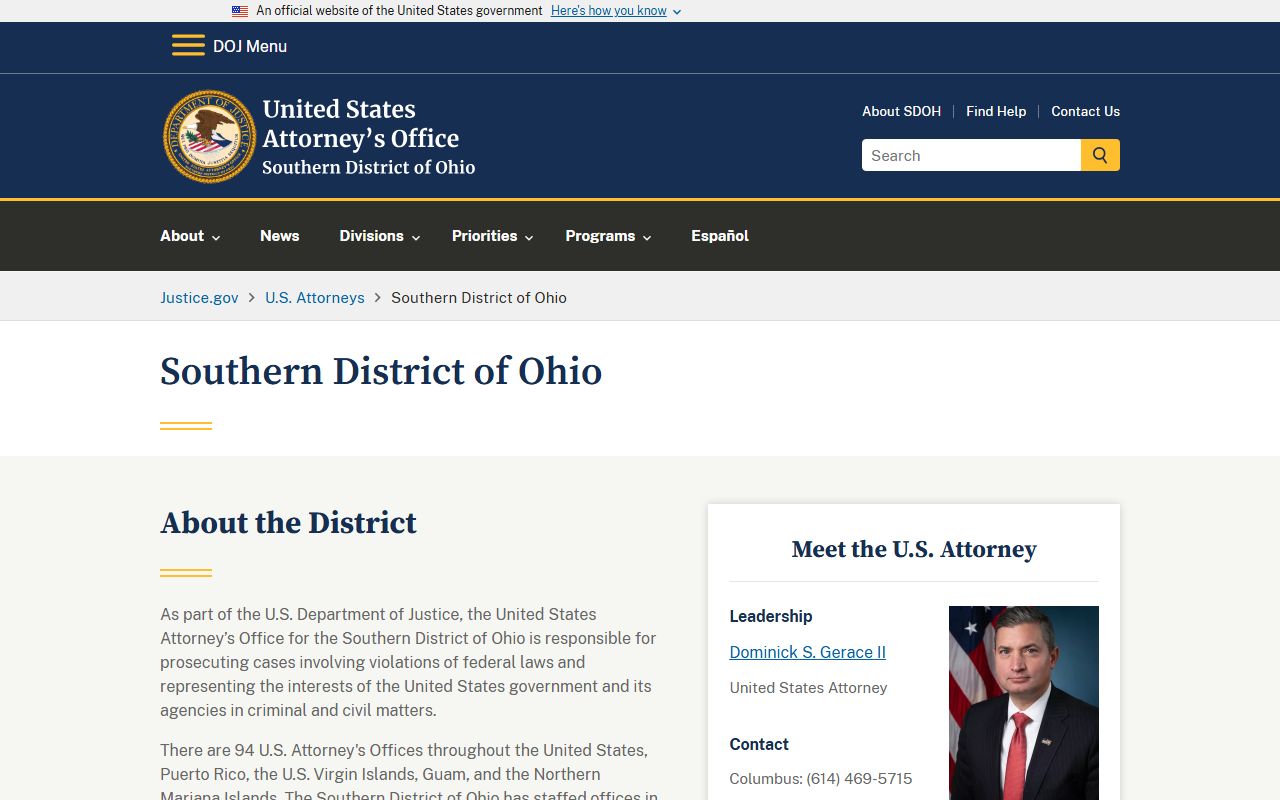
Federal warrant information is not included in the Hamilton County Clerk's public docket. To search federal cases touching Hamilton County, use PACER at pacer.uscourts.gov. Federal indigent defendants are served by the Federal Public Defender for the Southern District of Ohio, Cincinnati office.
The screenshot below shows the DOJ release naming Dominick S. Gerace II as U.S. Attorney for the Southern District of Ohio, sworn in on August 11, 2025. The U.S. Attorney leads federal criminal prosecution in the district, which covers Hamilton County and much of southern Ohio.
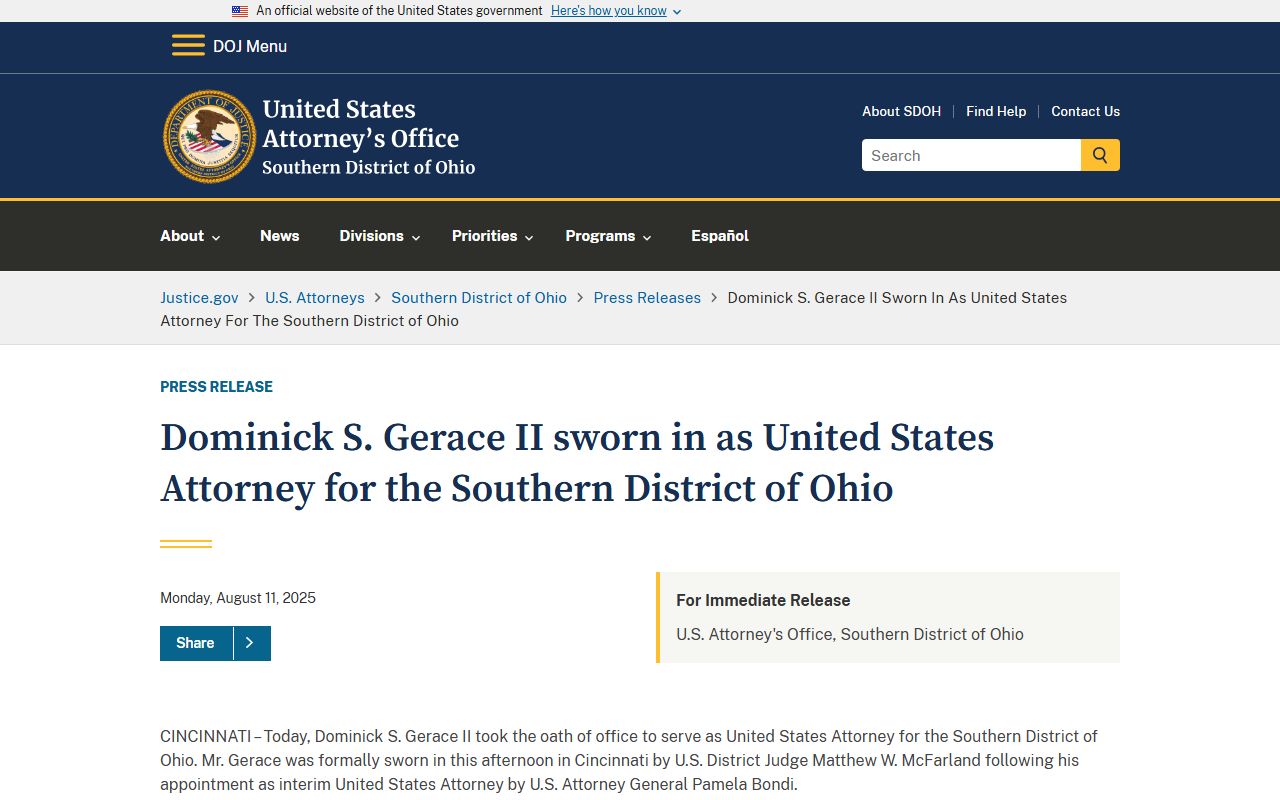
Federal warrant activity involving Hamilton County residents can result in detention at the Hamilton County Justice Center under a federal hold, even though the underlying case is in federal court. In that situation, the HCSO inmate search may show the person in custody, but the warrant and case details are in the federal PACER system, not the county Clerk portal.
Restricted Warrant Records in Hamilton County
Not every warrant or capias is visible in the public docket. Ohio law and court rules create several categories of records that are withheld from public access, and warrant records are subject to the same restrictions as other case documents.
Search warrants are commonly sealed while an investigation is active. Once proceedings are complete and the court unseals the record, the warrant may become visible in the docket. During the sealed period, searching the Clerk portal will not show the warrant. This is true even when law enforcement is executing the search and the investigation is known to the public through other channels.
Juvenile warrants are handled differently from adult warrants. Juvenile court records are restricted under Ohio law, and public online access is limited. R.C. 2151.14 governs juvenile court records and establishes special handling; sealing and expungement pathways are available under R.C. 2151.356 and R.C. 2151.358. A warrant or capias issued in juvenile proceedings is not searchable through the standard adult Clerk portal.
Adult records that have been sealed or expunged under R.C. 2953.31 through R.C. 2953.36 are removed from public access. If a warrant was issued in a case that was later sealed, the warrant entry is also removed from the public index. Government agencies and parties authorized by statute may still access sealed records in limited situations under R.C. 2953.34, but the general public cannot. Ongoing investigations and records of peace-officer residential information are also exempt under the Clerk's public-records policy and R.C. 149.43.
Note: Federal warrant records, including those for Hamilton County residents, are not part of the county Clerk's index and must be searched through PACER at pacer.uscourts.gov.HCSO Custody Check After a Warrant Arrest
When a Hamilton County warrant is served and the person is taken into custody, the next step is confirming jail status through the Hamilton County Sheriff's Office. Sheriff Charmaine McGuffey oversees the Justice Center at 1000 Sycamore Street, Cincinnati, OH 45202, which holds county inmates. The inmate search at hcso.org shows current custody status by last and first name. The Sheriff's page notes that housing location and other information are subject to change without notice.
The HCSO inmate search returns results from active custody at the Justice Center. If the person was recently arrested on a warrant but has already bonded out, they may not appear in the results. In that case, the Clerk docket will show the capias as served or the case will have a new hearing date entered. If the person was transferred to a state institution after a Hamilton County sentence, the Ohio Department of Rehabilitation and Correction offender search at appgateway.drc.ohio.gov is the next place to look. For federal custody, use the Bureau of Prisons inmate locator at bop.gov.
Families and attorneys who need ongoing notification when a person's custody status changes can sign up through VINELink at vinelink.com, which covers Hamilton County through the Ohio pathway. VINELink allows notification by phone, email, or text when a registered offender's custody status changes, which is useful when a warrant has been served and the person's release timeline is uncertain.