
Ohio Public Records Act Framework
The Ohio Public Records Act, R.C. 149.43, is the main law that governs access to government records in Ohio. It requires public offices to make records available for inspection and copying within a reasonable period. The law also sets out which records are exempt, what fees can be charged, and what happens when a request is denied. Public offices that get requests must respond promptly. Ohio courts have said that means as soon as possible given the nature, volume, and complexity of the request.
The definition of "records" matters. Under R.C. 149.011, a record is any document, device, or item created or received by or coming under the jurisdiction of a public office that documents the organization, functions, policies, decisions, procedures, operations, or other activities of the office. That is a wide net. It covers paper files, electronic records, emails, audio, video, photographs, and any other format. The Hamilton County Clerk of Courts cites that definition in its own public-records policy, effective October 1, 2020.
The Ohio Attorney General's Sunshine Laws resources offer plain-language guides, model public-records policy language, and training materials for both requesters and public offices. That office can also receive and investigate complaints when an agency refuses a valid request.
A separate layer of rules applies specifically to court records. The Ohio Supreme Court adopted Rules of Superintendence 44 through 47 (Sup.R. 44-47) to govern access to case documents and administrative records held by Ohio courts and clerks. Sup.R. 44 defines court records and case documents. Sup.R. 45 creates a presumption of public access but allows restrictions. Sup.R. 45(C) specifically says a clerk is not required to provide remote access to every case file or document. That rule is why the Hamilton County Clerk's website tells users that some documents exist but are not available online, and that visiting the office or submitting a copy request is required for those files. Sup.R. 46 covers bulk data and compiled information, which is why the Clerk bars data mining and bulk downloads. Sup.R. 47 provides the process a court must follow to restrict public access to a specific case document after required findings.
Note: The Ohio Public Records Act applies to county offices broadly. Court records follow both R.C. 149.43 and Sup.R. 44-47, so requesters may encounter both frameworks when asking for Hamilton County documents.
What Records Hamilton County Offices Maintain
Hamilton County public records are spread across several offices. The Clerk of Courts is the central record keeper for adult civil, criminal, and traffic court matters filed in the Court of Common Pleas, the Municipal Court, and the First District Court of Appeals. The Clerk's office also handles passport applications, auto titles, and watercraft titles. Beyond the Clerk, the Sheriff maintains records for law enforcement, jail operations, and body-camera footage. The Probate Court keeps its own set of estate, guardianship, marriage, and mental-health records. Other county departments hold land, budget, and administrative records.
The following categories of court-related public records are maintained by the Hamilton County Clerk of Courts under its unified adult-justice record-keeping function. See court records for full detail on each type.
- Common Pleas Civil case files: complaints, motions, orders, judgments, and cost statements
- Common Pleas Criminal case files: indictments, pleas, sentencing entries, post-conviction filings
- Municipal Civil records: small claims, evictions, garnishments, municipal civil classifications
- Municipal Criminal and Traffic records: misdemeanors, ordinance offenses, traffic tickets, criminal tickets
- Domestic Relations records: divorce, dissolution, custody, and support filings
- Court of Appeals records: notices of appeal, briefs, and appellate decisions
- Liens, certified mail records, notary records, and grand jury reports
Hamilton County Probate Court operates a separate public inquiry system covering probate cases, marriage license records, mental-health probate indexes, and an archive search reaching bound-volume records from 1791. Those records are searched through the Probate Court's own portal. See Probate Records for that process.
Hamilton County Clerk Public-Records Policy
The Clerk of Courts adopted a formal public-records policy effective October 1, 2020. That policy spells out several rules that differ slightly from what many people expect. No special language is required to make a request. The desired records must be identified with enough clarity that the office can locate, retrieve, and review them. An unclear request will be met with a contact for clarification rather than a flat denial. The office will also explain its legal authority when it redacts or denies records.
Requesters are not required to give their name or say why they want the records. Ohio law does not allow public offices to demand identification or purpose as a condition of access. In-person requesters at the Clerk's office do not have to put the request in writing at all. However, if the office needs to reach you about clarification, a delivery method, or fees, providing a contact is a practical necessity. Commercial requesters have a stricter rule: they are limited to no more than 10 records per month per company and all commercial requests must go through publicrecords@cms.hamilton-co.org. If a requester does not certify they are non-commercial, the Clerk treats the request as commercial.
The Clerk's online portal notes that data-mining efforts have hampered the redaction process. Some document requests may require a second request to allow the office time to complete required redactions. The Clerk can deliver unredacted portions while the remaining review continues. Redactions required by Ohio law or court order are visibly marked on returned records. If hand redaction is required, costs may apply even when records are delivered electronically.
How to File a Hamilton County Public Records Request
The submission path depends on which office holds the records. For Clerk of Courts records, the main request channel is the online form at the Clerk Request Record page. The Clerk instructs requesters to be as descriptive as possible. For Sheriff records, including body-camera footage, the request goes through the HCSO public records request form. Other county departments have their own request contacts; when in doubt, the Ohio Attorney General's Sunshine Laws page lists the framework that applies statewide.
- Identify the right office. Decide whether the record is a court filing (Clerk), a law-enforcement report or body-camera video (Sheriff), a probate or marriage record (Probate Court), or a general county administrative record. Each office is the keeper for its own documents.
- Describe the record with enough clarity. Give the case number if you have one. Include party names, filing dates, document type, and court division. For non-court records, describe the subject, the date range, and the type of document. Vague requests cause delays because the office must ask for clarification before it can search.
- Submit through the correct channel. For Clerk records: use the online request form or visit Room 315, 1000 Main Street, Cincinnati, OH 45202. In-person requests do not need to be in writing. For the Sheriff: use the online form at hcso.org/public-records-requests/. For probate: contact Probate Court at 230 East Ninth Street, 9th and 10th floors.
- Wait for the office to respond. Ohio law requires a response within a reasonable period. If your request is not clear, the office will contact you. If the records are archived or on microfilm, expect additional processing time. The Clerk states this clearly on its request page.
- Pay any applicable fees and receive the records. Plain copies cost $0.10 per page. Certified copies cost $1.00 per page and cannot be sent electronically. Video-record preparation under R.C. 149.43(B)(1) may carry a charge up to $75 per hour and $750 total in non-victim cases. After paying, the records are provided in the format specified.
If your request is denied or partially denied, the office must tell you the legal authority for the denial. You can then contact the Ohio Attorney General's office or file a mandamus action in court to compel disclosure.
Public Records Request Form Fields
The Hamilton County Clerk's document-request workflow does not expose a printed PDF form with a single required layout. Instead, the online form and in-person process gather information based on what is needed to process each request. The table below reflects the fields captured from the Clerk's Request Record page and the Clerk's public-records policy. A parallel table follows for the Hamilton County Sheriff's Office public-records request web form.
| Field | Required | Notes |
|---|---|---|
| Requester name | Not required by law | Ohio law does not require requesters to identify themselves; contact info may be practical for delivery. |
| Contact method (email or phone) | Practical requirement | Questions go to publicrecords@cms.hamilton-co.org; needed if the office must clarify or deliver records. |
| Case number | Optional but strongly recommended | The Clerk stresses clarity; page numbers appear in the View Case Documents tab when a case is open. |
| Court or division | Unspecified; aids processing | Common Pleas Civil, Common Pleas Criminal, Municipal Civil, Municipal Criminal/Traffic, Domestic Relations, or Court of Appeals. |
| Document description | Yes for processing | Must identify the desired records with enough clarity to locate, retrieve, and review them. |
| Delivery method | Unspecified | Electronic delivery may still carry redaction costs; certified copies cannot be sent electronically. |
| Commercial-request certification | Conditional | If not certified non-commercial, the Clerk treats the request as commercial and applies the 10-records-per-month cap. |
The Hamilton County Sheriff's Office uses a separate web form for public-records requests, including body-camera footage and law-enforcement reports. The HCSO form is available at the Sheriff's public records request page. The image below shows that form as captured from the Sheriff's website.
The HCSO public records request page provides the official web form for requesting Sheriff records, including body-camera footage subject to R.C. 149.43(B)(1).
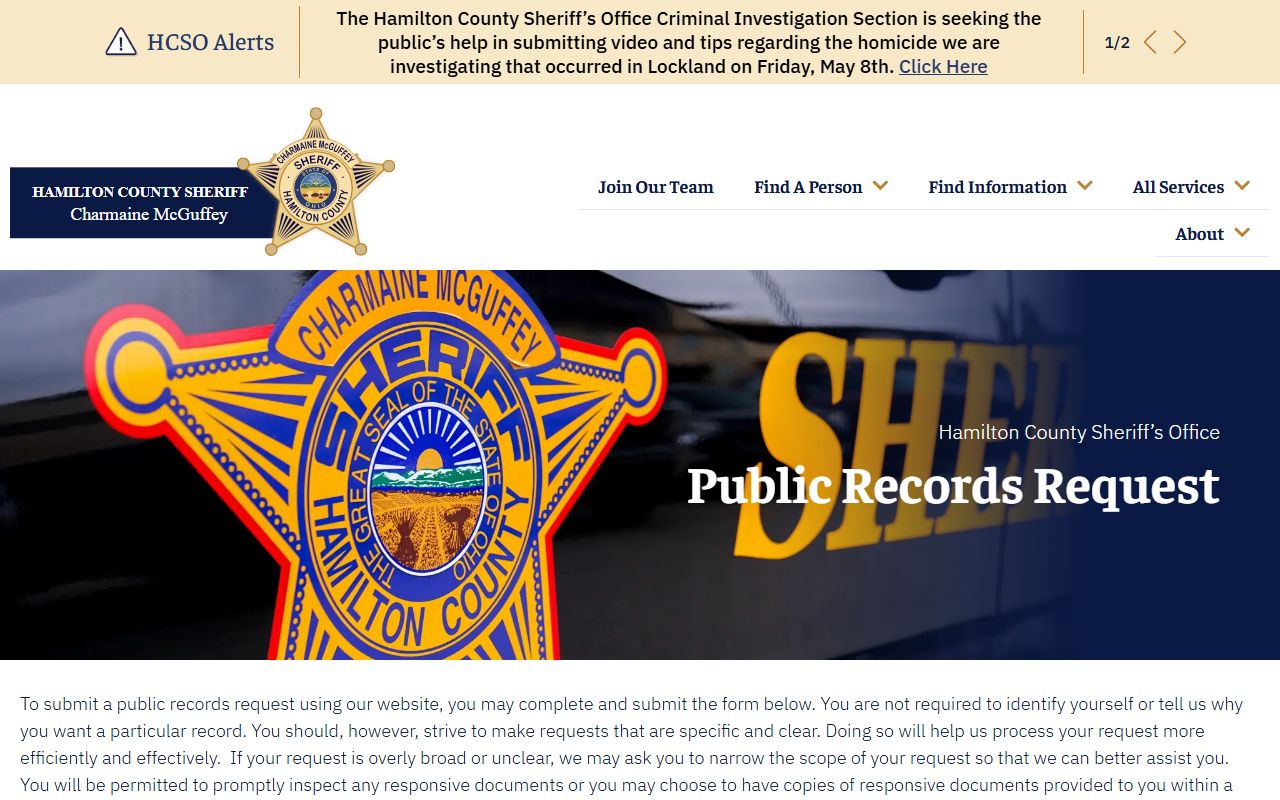
Body-camera footage is among the records that can be requested through the Sheriff's form. Under R.C. 149.43(B)(1), preparation charges for video records may reach $75 per hour and $750 total when the case does not involve a crime victim.
| HCSO Request Field | Required | Notes |
|---|---|---|
| Requester name | Form collects | Sheriff form gathers contact details; Ohio law still does not require identification as a condition of access. |
| Contact email or phone | Practical requirement | Needed for follow-up, fee notice, and record delivery. |
| Record description | Yes | Describe the incident, date, involved parties, report number, or other identifying details. |
| Date range | Helpful | Narrows the search to specific dates for incident reports or body-camera footage. |
| Record type | Helpful | Specify incident report, body camera, dispatch log, or other record category. |
Response Timelines for Hamilton County Requests
Ohio does not set a fixed number of days for public-records responses the way some states do. The standard under R.C. 149.43 is that a public office must make records available for inspection at a reasonable time and within a reasonable period. Courts interpreting this standard look at the volume of the request, the complexity of any required review, and whether redactions are needed. Routine requests that produce a few pages should be handled quickly. Large requests, or those involving older archived records or required redactions, may take longer.
When a Clerk request involves archived or microfilm records, the Clerk's policy says processing may be delayed. The office contacts the requester if it needs clarification before it can search. If part of a document must be redacted, the Clerk may release the unredacted portion while completing review of the rest. The data-mining notice on the Clerk's site also warns that some document requests may require a second request because the redaction process has been strained. Commercial requesters face the added step of using the dedicated email address and staying within the 10-records-per-month cap.
If a request is denied, the public office must give the legal basis. From there, a requester can file a complaint with the Ohio Attorney General or bring a mandamus action in the Court of Common Pleas or an appellate court. If a requester wins a mandamus action, the court can award court costs and attorney fees when the denial was not substantially justified.
Public Records Fees in Hamilton County
Fee rules for Hamilton County public records come from R.C. 149.43 and the Clerk's published policy. The Clerk can charge for the actual cost of supplying records in a given format. Paper copies have a set per-page rate. Certified copies cost more and carry delivery restrictions. Video records may carry labor charges. Local government requesters get copies at no cost. The table below lists the fees confirmed in the Clerk's published policy.
| Item | Amount |
|---|---|
| Plain copy of a Clerk record | $0.10 per page |
| Certified copy | $1.00 per page |
| Certified copy delivery | Cannot be sent electronically; must be picked up or mailed |
| Local government or county agency | Free |
| Photos, disks, or other media | Actual cost |
| Mailing | Advance postage and mailing-supply cost may be charged |
| Video-record preparation (law-enforcement footage, non-victim case) | Up to $75 per hour; $750 maximum per R.C. 149.43(B)(1) |
| Hand-redaction labor | May apply even for electronic delivery when hand redaction is required |
Certified copies are the most commonly needed documents for legal proceedings such as divorce, name change, mortgage refinance, or probate. The $1.00-per-page rate applies to each certified page, and because they cannot be emailed, plan for in-person pickup or mailing. Plain copies at $0.10 per page are fine for research or review but will not be accepted in most courts or agencies as official proof.
Court Record Access Rules in Hamilton County
Court records in Hamilton County follow a framework that layers on top of the general Ohio Public Records Act. The Supreme Court of Ohio's Rules of Superintendence 44-47 create the governing structure. Sup.R. 44 defines what counts as a court record versus an administrative document, which affects what is subject to the presumption of access. Sup.R. 45 establishes that court records are presumed open to the public but lists specific grounds for restriction. Sup.R. 47 tells courts what findings they must make before sealing or restricting access to a specific case document.
The practical impact in Hamilton County is Sup.R. 45(C). The Clerk is not required to provide remote access to every document in every case file. That is why the Clerk's records-search site prominently displays this notice: if a file or document exists but is not available online, the requester must visit the Clerk's office or file an online copy request. This does not mean the record is sealed or exempt. It means the Clerk has not published it to the web interface, and the in-person or request process is needed. Many older records, archived microfilm materials, and documents requiring hand redaction fall into this category.
The Sup.R. 46 bulk-data restriction is also active. The Clerk bars data mining and bulk downloads. Users who repeatedly scrape the records-search portal may be blocked. Businesses that need multiple records must use the commercial-request channel with the 10-records-per-month cap and the dedicated email. That limit applies across all agents of a company, not just per individual user.
For federal court records in Hamilton County, the primary system is PACER (Public Access to Court Electronic Records), which covers the U.S. District Court for the Southern District of Ohio and the U.S. Bankruptcy Court. PACER charges $0.10 per page for most documents, with a quarterly cap for small users. The screenshot below is from the PACER portal, which provides access to federal civil, criminal, and bankruptcy records for cases heard in Cincinnati.
Federal court electronic records for Hamilton County are available through PACER at pacer.uscourts.gov, covering the Southern District of Ohio's Cincinnati seat and the federal Bankruptcy Court.
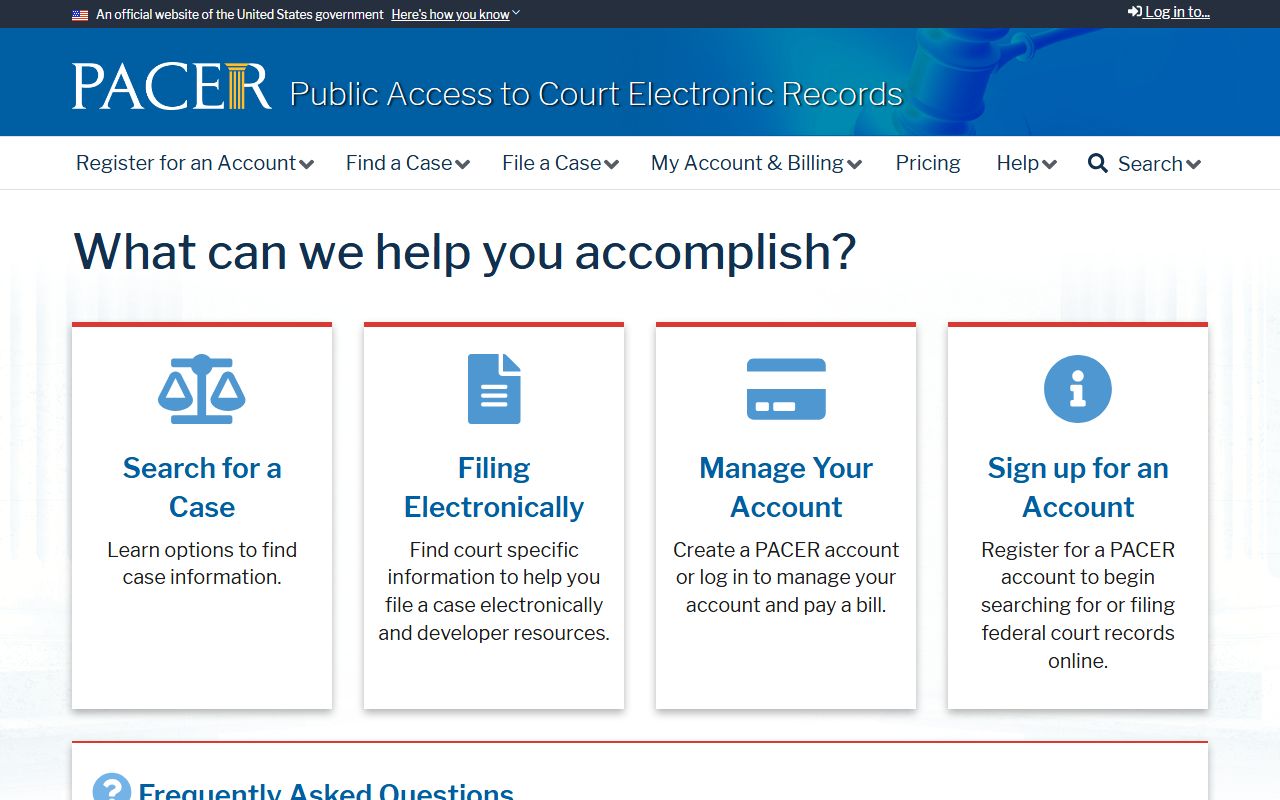
PACER registration is free. Fees apply per page of documents retrieved, though accounts that accumulate less than $30 in quarterly charges are generally not billed. Civil, criminal, and bankruptcy dockets for Hamilton County federal cases are all accessible after registration.
Records That Are Exempt or Redacted
Not every Hamilton County record is open to the public. The Ohio Public Records Act and court rules create specific categories that are exempt from disclosure or that must be redacted before a record is released. The Clerk's public-records policy identifies the following categories as exempt or subject to redaction when they appear in records the Clerk holds.
- Social Security numbers and other personal identifiers
- Medical records
- Ohio BMV driver records (those must be requested through the Ohio BMV, not the Clerk)
- Records of ongoing investigations
- Residential and familial information of peace officers, firefighters, EMTs, prosecutors, children-services workers, and corrections officers
- Juvenile court records, which are restricted under Ohio juvenile statutes and court rules
- Sealed and expunged adult criminal records, where access is removed or records are destroyed under R.C. 2953.31 through 2953.36
- Mental-health probate details, which may be limited by court order and confidentiality rules beyond the basic index
- Adoption records, which are generally confidential and require statutory authorization or a court order to access
- Records that a judge has specifically ordered sealed by court entry
Ohio's adult sealing and expungement process starts with eligibility under R.C. 2953.32. The applicant files in the court that handled the original case. The court must weigh statutory eligibility, pending proceedings, rehabilitation, and whether the government's need outweighs the applicant's interest in sealing. If granted, index references are removed and official records are sealed or destroyed subject to limited statutory exceptions. Juvenile records follow a separate pathway under R.C. 2151.356 (sealing) and R.C. 2151.358 (expungement).
When the Clerk redacts a document, the redaction is visibly marked on the returned record. The legal basis for the redaction must be provided if the requester asks. If only part of a document is exempt, the non-exempt portions must still be released. The office cannot withhold an entire document just because one section is protected.
Note: Driver records are kept by the Ohio BMV under R.C. 4507.021 and are not part of the Clerk's court records. Requests for a driver history must go directly to the Ohio BMV.
Clerk of Courts Office and Contact
The Hamilton County Clerk of Courts is led by Pavan V. Parikh, who was appointed in December 2021 and elected in 2022 and 2024. The Clerk's office serves as the official record keeper and agent of Hamilton County's adult justice system. Deputy Clerks accept, manage, and retain legal documents filed through the Municipal Court, the Court of Common Pleas, and the First District Court of Appeals. Most public-records requests for court files go through this office.
The main Clerk counter for civil and criminal Common Pleas records is Room 315 at the courthouse. The Municipal Criminal and Traffic counter is at the Justice Center on Sycamore Street, with extended hours and a 24/7 bond window. Use the contact information below to reach the right counter for your request. See the Clerk of Courts page for a full breakdown of divisions, hours, and forms.
1000 Main Street, Room 315
Cincinnati, OH 45202
Phone: 513-946-5699
Hours: Monday-Friday, 8:00 a.m. to 4:00 p.m.
Commercial records requests: publicrecords@cms.hamilton-co.org
The Municipal Criminal and Traffic Clerk is located at 1000 Sycamore Street, Room 115, Cincinnati, OH 45202. That counter is open Monday-Friday 8:00 a.m. to 8:00 p.m. with a bond window and police attorney counter operating 24 hours a day, seven days a week. Traffic tickets and misdemeanor criminal records are handled there rather than at the main courthouse counter.
When a Hamilton County Public Records Request Is Denied
Ohio law gives requesters a clear path when a public office refuses or fails to provide records. The office must identify the legal authority for any denial or redaction. That is not optional. If the Clerk or Sheriff withholds a record, the written or oral response must cite the specific exemption or court rule that applies.
A requester who believes a denial is wrong has two main options. First, file a complaint with the Ohio Attorney General's Sunshine Laws unit. The AG can investigate and issue a non-binding finding. That finding does not force disclosure but it puts pressure on the public office and creates a record. Second, file a mandamus action in court. Mandamus is a lawsuit that asks a court to order the public office to produce the record. If the requester wins, the court can award court costs and, when the denial was not substantially justified, attorney fees. The case goes to the Ohio Court of Common Pleas or an appropriate appellate court depending on which court has jurisdiction.
For court dockets or case documents that are withheld under Sup.R. 47, the restriction requires specific written findings by the court. A person who wants to challenge that restriction can file a motion in the case to lift or modify the order. That is different from a public-records mandamus action and stays within the original case docket.
Legal Help with Hamilton County Public Records
Getting records on your own is often straightforward. But sometimes a request hits a wall: the office says the records are exempt, the response is unclear, or a needed record is sealed. Several resources in Hamilton County and Ohio can help people navigate these situations without hiring a private attorney.
The Hamilton County Help Center, linked directly by the Clerk of Courts, assists self-represented litigants with common civil and court-navigation questions. Ohio Legal Help at ohiolegalhelp.org covers public records, sealing and expungement, family law, and housing in plain language. The Legal Aid Society of Greater Cincinnati serves low-income residents with housing, family, benefits, and consumer civil legal problems. The Hamilton County Public Defender handles indigent criminal defense for those who qualify.
If you need a private attorney for a public-records dispute or a sealing/expungement case, the Ohio State Bar Association lawyer-referral service connects people with licensed Ohio attorneys. The screenshot below shows the OSBA lawyer-referral resources page.
The Ohio State Bar Association lawyer-referral page connects Hamilton County residents with licensed attorneys for court-records and public-records matters.
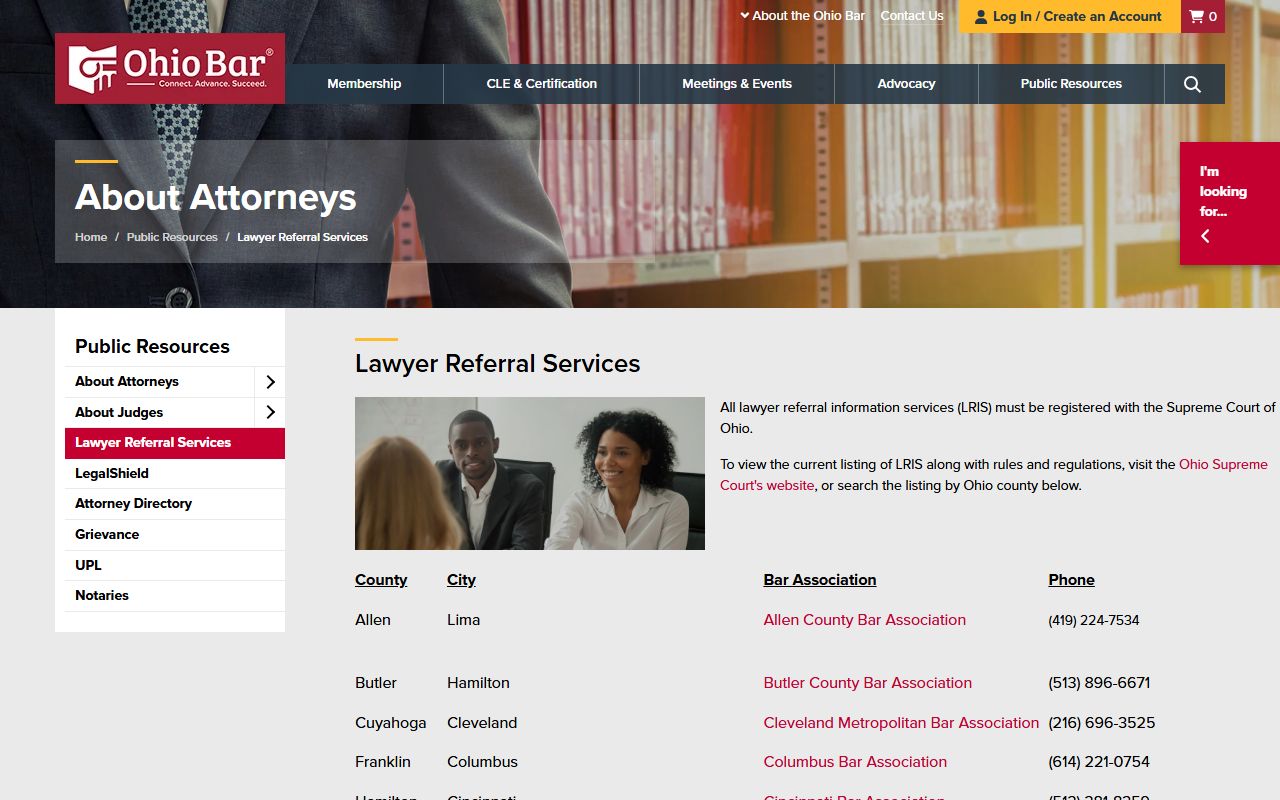
Referrals through the OSBA are a practical first step when a public-records denial involves disputed legal grounds, or when a sealing or expungement petition needs legal review before filing in the Hamilton County Court of Common Pleas.