
How to Look Up Hamilton County Jail Population Data
The Hamilton County Sheriff's Office Justice Center services page is the official county starting point for jail information. It links to inmate search, inmate correspondence, visitation, and jail services. HCSO does not maintain a separate public dashboard that shows daily or weekly jail counts, a current census, or a historical population graph. The Sheriff's inmate search at hcso.org/justice-center-services/inmate-search/ reflects who is in custody at the moment of the query, but it does not produce aggregate population numbers. Official population reports have not been located on the HCSO site. HCSO does accept public-records requests through its online request form under Ohio R.C. 149.43; a written request for population statistics or census data submitted through that form is the best channel for obtaining county-level figures directly from the source.
For state and national context, the Vera Institute of Justice Incarceration Trends tracks Ohio jail population patterns and was updated for Ohio data on October 16, 2024. The Bureau of Justice Statistics publishes annual jail inmate counts and rates per 100,000 U.S. residents through its Census of Jails and Annual Survey of Jails programs. These two sources together give the clearest picture of where Ohio and Hamilton County fit within the national jail landscape. Where county-specific figures are absent, the data on this page draws from those verified state and national reports. Any figure labeled "county" below is either confirmed by an official county source or explicitly marked as not published.
The official biography for Hamilton County Sheriff Charmaine McGuffey is shown below. Sheriff McGuffey, a 35-year HCSO veteran and the highest-ranking woman in the office's history, took office January 4, 2021, and has oversight of the Justice Center jail operations.
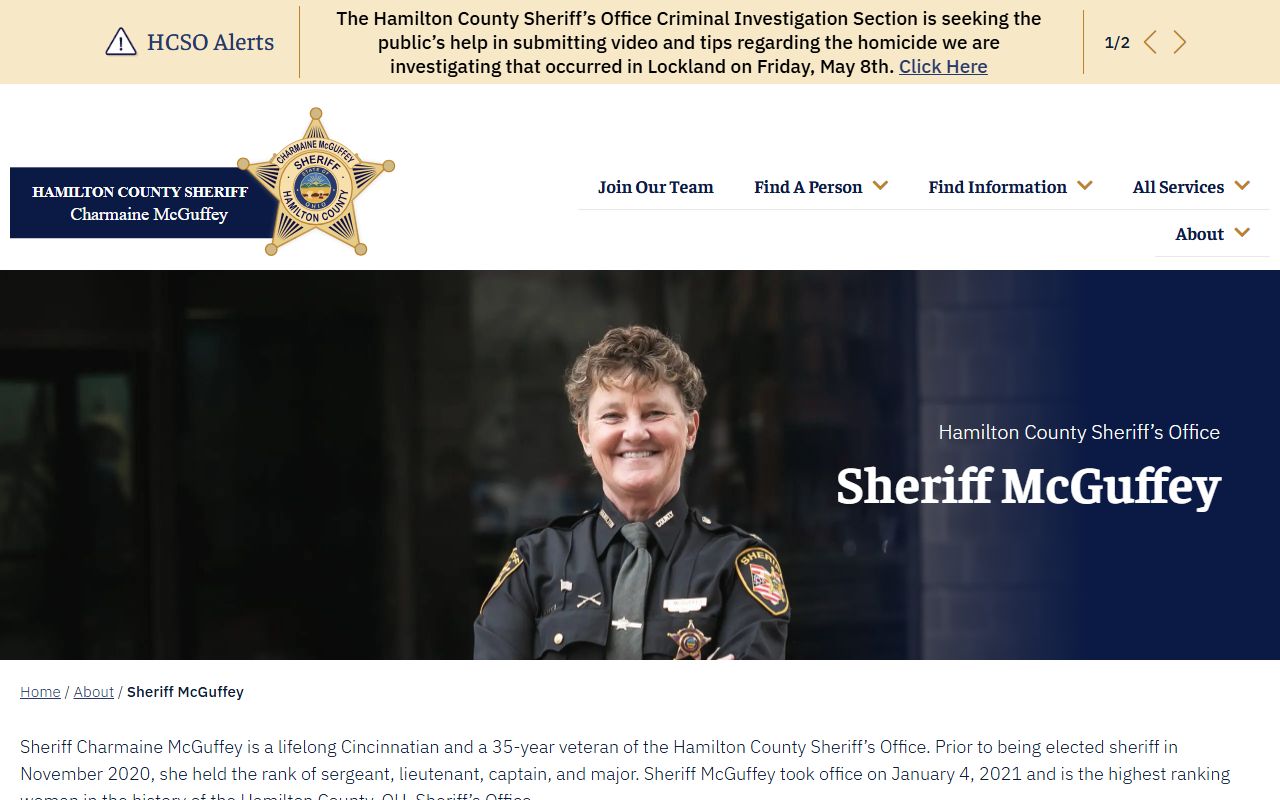
The Sheriff's biography describes her background in jail and court services, corrections academy command, and jail reform, all of which directly shape how the Hamilton County Justice Center is managed day to day.
Hamilton County Jail Capacity Overview
The Hamilton County Justice Center at 1000 Sycamore Street, Cincinnati, operates out of North and South Buildings. The facility handles adult pretrial detention and sentenced populations under HCSO oversight. HCSO corrections officers work 12-hour shifts, either 7 a.m. to 7 p.m. or 7 p.m. to 7 a.m., with occasional mandatory overtime and one mandatory shift every 30 days. The corrections academy for new officers runs 10 weeks and covers inmate communication and de-escalation, physical conditioning, defensive tactics, first aid, and applicable laws and regulations. The academy's curriculum reflects the treatment-and-custody balance that the Justice Center operates under daily.
A rated capacity figure for the Justice Center has not been published on the HCSO website pages inspected during research. Unofficial jail-roster aggregator sites report capacity numbers, but those sources are not used here. The table below reflects what HCSO officially confirms: the facility name, address, phone contacts, and the status of published capacity data.
| Facility / Unit | Address | Phone | Rated Capacity |
|---|---|---|---|
| Hamilton County Justice Center (North & South Buildings) | 1000 Sycamore St, Cincinnati, OH 45202 | 513-946-6400 | Not published by HCSO |
| Inmate Accounting | Justice Center North Building, Room 120 | 513-946-6630 | N/A (administrative unit) |
| Inmate Property | Justice Center South Building | 513-946-6330 | N/A (administrative unit) |
Note: HCSO accepts public-records requests at hcso.org/public-records-requests/ for records not available online, including operational or census-type data that may exist in internal reports.
Average Daily Population
Average daily population, or ADP, is the standard measure jails use to track how many people are in custody on an average day during a given period. It is distinct from peak census figures or a point-in-time count. The Hamilton County Sheriff's Office has not published an ADP figure on its public-facing pages. No county ADP for a recent year was found during research. Because this number is not officially available, it is not reported here.
Nationally, the Bureau of Justice Statistics tracks ADP for jails across the country through its Census of Jails and Annual Survey of Jails programs. Those surveys show that large urban county jails often operate close to or above their rated capacity, and that the COVID-19 period in 2020 caused sharp but temporary drops in ADP across nearly all jurisdictions. Most county jails began recovering toward pre-pandemic census levels by 2022 and 2023. Hamilton County is Ohio's third-largest county and is home to Cincinnati, so its jail population tends to follow patterns seen in large metro jails rather than small rural facilities.
Researchers, journalists, or attorneys who need a county-specific ADP can submit a public-records request to HCSO. Ohio R.C. 149.43 requires public offices to provide records promptly, and HCSO must respond within a reasonable time or explain any legal basis for withholding data. The request form is available online through the Sheriff's website.
Demographic Breakdown
HCSO does not publish a demographic breakdown of the Justice Center population on its public pages. Gender, race, age, and citizenship distributions for people in Hamilton County custody have not been located in official county sources during research. The table below reflects this gap honestly rather than substituting estimates.
| Demographic Category | Hamilton County Figure | Source |
|---|---|---|
| Gender breakdown | Not published by HCSO | HCSO public pages |
| Race/ethnicity breakdown | Not published by HCSO | HCSO public pages |
| Age distribution | Not published by HCSO | HCSO public pages |
At the national level, BJS jail data consistently shows that adult jail populations are predominantly male, typically around 85 percent, with a range depending on facility type and jurisdiction. Racial and ethnic distributions vary substantially by region and county. Ohio-specific demographic data for county jails may be available through the Ohio Department of Rehabilitation and Correction's annual reports, though county jail data and state prison data are tracked separately. For Hamilton County-specific demographic figures, a public-records request to HCSO or a request through the Ohio Attorney General's public-records resources is the most reliable path.
Pretrial vs. Sentenced Population in Hamilton County
The pretrial share of the jail population is one of the most closely watched jail metrics nationally. People held pretrial have not been convicted; they are awaiting a court date, a bail hearing, or a trial. Sentenced people in local jails are typically serving short terms of less than one year or waiting to be transferred to a state prison after sentencing. In Hamilton County, HCSO does not publish a pretrial-versus-sentenced breakdown on its public-facing pages. That figure is not available from official county sources at this time.
Ohio-level data from the Vera Institute of Justice, updated October 16, 2024, reports that 62 percent of Ohio's jail population is held pretrial statewide. That is a notably high share. It means that most people in Ohio county jails on any given day have not yet been convicted of the charge that put them there. They are waiting for the legal process to move forward. Many factors drive a high pretrial rate: bail-setting practices, the pace of case processing in local courts, the availability of pretrial services programs, and whether alternatives to detention exist in the county.
Hamilton County courts, including the Court of Common Pleas and the Municipal Court, handle the bail and pretrial supervision decisions that shape the Justice Center's pretrial count. The Common Pleas specialized dockets, including Drug Court, Mental Health Court, and the Reentry Docket, are designed in part to move people out of custody into supervised community programs. Those programs can reduce the sentenced and post-conviction portion of the jail census. The comparison table in the National and State Context section below shows how the county, state, and national pretrial figures line up.
Misdemeanor vs. Felony Population
In Ohio, local jails like the Hamilton County Justice Center hold people charged with or convicted of both misdemeanors and felonies. The Municipal Court handles misdemeanor criminal cases and can sentence people to up to 180 days in the local jail for a first-degree misdemeanor. The Court of Common Pleas handles felony cases; people convicted of felonies are typically sentenced to state prison, but they can serve time in the county jail under certain circumstances, including shorter felony sentences and post-release community control.
HCSO does not publish a charge-type breakdown showing the share of the Justice Center population held on misdemeanor charges versus felony charges. That split, which would help identify how much of the jail population flows from Municipal Court versus Common Pleas, is not in the publicly available data from official sources. State-level BJS data shows that misdemeanor defendants make up a large fraction of local jail admissions nationally, but they also cycle through faster than felony defendants because their cases resolve more quickly or their bail is lower. The annual admission count can therefore look very different from a point-in-time census count when it comes to misdemeanor-versus-felony breakdown.
Mental Health and Medical Population
Mental illness and medical need in the jail population are acknowledged challenges at the county level. The Hamilton County Court of Common Pleas operates a dedicated Mental Health Court, with Hon. Alison Hatheway, Hon. Jody M. Luebbers, Hon. Katie Casch, and Hon. Virginia Tallent listed as participating judges. The docket is designed for people whose mental illness intersects with criminal charges. It connects participants with treatment and supervision rather than holding them in the general jail population. The Hamilton County Reentry Docket, under Presiding Judge Wende C. Cross, also targets people leaving state prison who need structured reentry support, which can include mental health and substance use services.
HCSO's 10-week corrections academy includes training in inmate communication and de-escalation, which is directly relevant to managing people with behavioral health needs. The Vera Institute has noted nationally that the growth of the pretrial population has driven more people with untreated mental illness into local jails, because jails have become the default point of contact when community mental health systems are inadequate. HCSO does not publish data on what share of the Justice Center population receives mental health treatment or medical services at any point. That information is not available from official public pages and would require a records request to obtain.
National and State Context for Jail Population
The Bureau of Justice Statistics jail reports show that local jails held approximately 665,000 to 745,000 people on any given day in the years leading up to and immediately following the COVID-19 period, with a sharp drop in 2020 and gradual recovery through 2022 and 2023. The national jail incarceration rate runs near 220 per 100,000 U.S. residents, though it varies widely from state to state and county to county. Large urban counties like Hamilton County tend to have different dynamics than rural counties: they have more people cycling through the system, more specialized courts, and more pretrial services, but also more complex caseloads and higher housing costs that affect bail outcomes.
Ohio's Vera Institute data, updated October 16, 2024, documents 413,269 annual local jail admissions statewide. That figure reflects the churn in and out of facilities across all Ohio county jails in a year, not a single-day count. It underscores how much activity flows through local jails even in counties that may have relatively modest average daily populations. The 62 percent pretrial rate in Ohio sits above the national average, which hovers in the range of 65 to 68 percent in more recent BJS reporting, meaning Ohio is close to the national pattern but the county-by-county spread can be significant. Hamilton County's own pretrial share is not confirmed by official data.
The following comparison block shows the pretrial rate at three levels. Hamilton County's figure is not published by HCSO, so it is marked accordingly. The state figure comes from Vera Institute data updated October 16, 2024. The national figure reflects BJS annual jail reporting for recent survey years.
| Level | Pretrial Share of Jail Population | Source |
|---|---|---|
| Hamilton County | Not published by HCSO | HCSO public pages |
| Ohio (statewide) | 62% pretrial | Vera Institute, updated Oct. 16, 2024 |
| United States (national) | Approx. 65-68% pretrial (varies by survey year) | Bureau of Justice Statistics annual jail reports |
VINELink, shown below, provides a custody-notification service that lets victims and community members register to receive alerts when an inmate's custody status changes in Hamilton County. It is one of the few publicly accessible tools that touches real-time jail population changes at the individual level, even if it does not report aggregate counts.
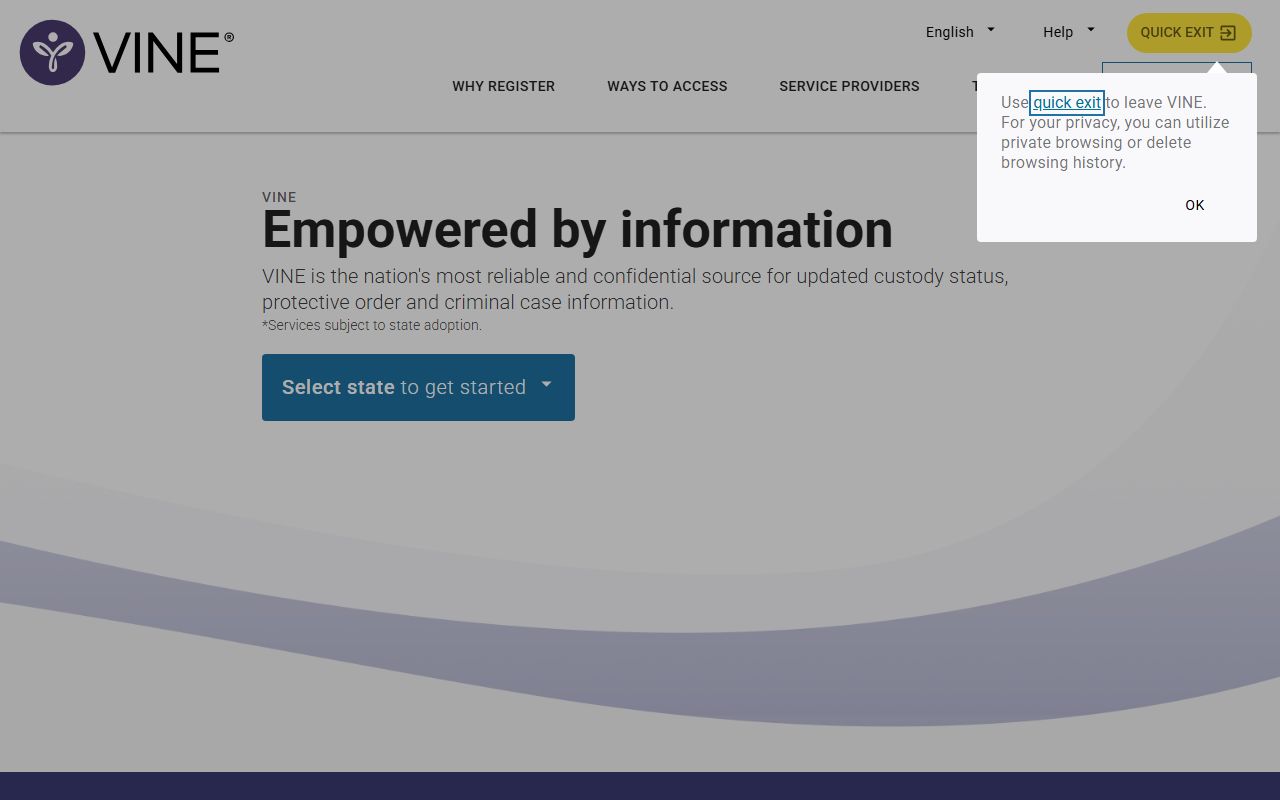
VINELink searches custody records for Ohio facilities including the Hamilton County Justice Center; registered users receive automatic notifications when an inmate is released, transferred, or has a status change.
Population Trends Over Time
Multi-year jail population trend data for Hamilton County has not been located in official HCSO publications. The Sheriff's Office does not appear to publish an annual report with population trend charts, cost-per-inmate figures, or year-over-year comparisons on its public web pages. That data gap is a real one. Budget documents, audit reports, or performance reports filed with Hamilton County government may contain population trend data, and those documents are public records under Ohio R.C. 149.43 and available through the county or through a public-records request to HCSO.
What official sources do confirm is that HCSO has operated the Justice Center across both the pre-pandemic and post-pandemic periods, that specialized dockets at the Court of Common Pleas have expanded since Hamilton County's Drug Court was established as the first in Ohio, and that the Reentry Docket under Judge Cross targets a population that would otherwise cycle back into custody. Each of these programs can affect population trends over time by diverting participants out of the general population or reducing recidivism that would otherwise add to the census. The trajectory of those programs, and how much they have moved the jail count, is a question that county budget and performance data would answer.
At the state level, Vera Institute Ohio data shows that Ohio's jail population followed national trends: growth through the 2000s and 2010s, a drop in 2020, and a partial recovery since. Whether Hamilton County tracked the state average, ran above it, or ran below it across that span is not determinable from publicly posted HCSO data alone. Anyone researching the trend for advocacy, litigation, or policy purposes should start with a public-records request and, as a parallel step, check Hamilton County budget cycle documents that are posted by the county commissioners.
Searching for Hamilton County Inmate Records by Name
The population figures and context on this page are aggregate data, not individual records. To look up a specific person currently in Hamilton County custody by name, use the Hamilton County inmate records page, which covers the HCSO live jail roster search at hcso.org. For people who may have been released, see the released inmates page covering HCSO search, VINELink notifications, Ohio ODRC offender search, and BOP locator tools. For people wanted on active warrants, see Hamilton County warrant records. The roster and warrant tools are name-based searches of live or near-live data, which is a different function from the population statistics covered here.
Where the Data Comes From
The official source for Hamilton County jail information is the Hamilton County Sheriff's Office. The HCSO website at hcso.org covers Justice Center services, inmate search, inmate information, visitation, mail, commissary, and public-records requests. Population data, capacity tables, and ADP figures are not currently posted on those pages. Any Hamilton County-specific number must therefore come from a public-records request to HCSO or from an official county budget/audit document. HCSO's public-records request form is at hcso.org/public-records-requests/, and requests are governed by Ohio R.C. 149.43.
State-level jail data comes from the Vera Institute of Justice Incarceration Trends tool, which compiled Ohio figures updated October 16, 2024. Vera's Ohio data includes the 62 percent pretrial rate and the 413,269 annual local jail admissions figure. Vera draws on a combination of BJS survey data and state-level reporting, so its figures are grounded in official surveys even when direct county data is sparse.
National jail data comes from the Bureau of Justice Statistics, which operates the Census of Jails and the Annual Survey of Jails. BJS publishes reports on total jail population, ADP, pretrial rates, demographic breakdowns, and trends over time for local jails across the United States. These reports are the standard citation in criminal-justice policy research and litigation. The most recent BJS jail inmate reports are available at no cost on the BJS website and are updated as new survey cycles are completed.
For individual-level Hamilton County custody data, the HCSO inmate search at hcso.org/justice-center-services/inmate-search/ is the official county tool. For arrest and criminal records tied to Hamilton County cases, the Clerk of Courts is the record keeper through the court-records portal at courtclerk.org.